⬛ Studies
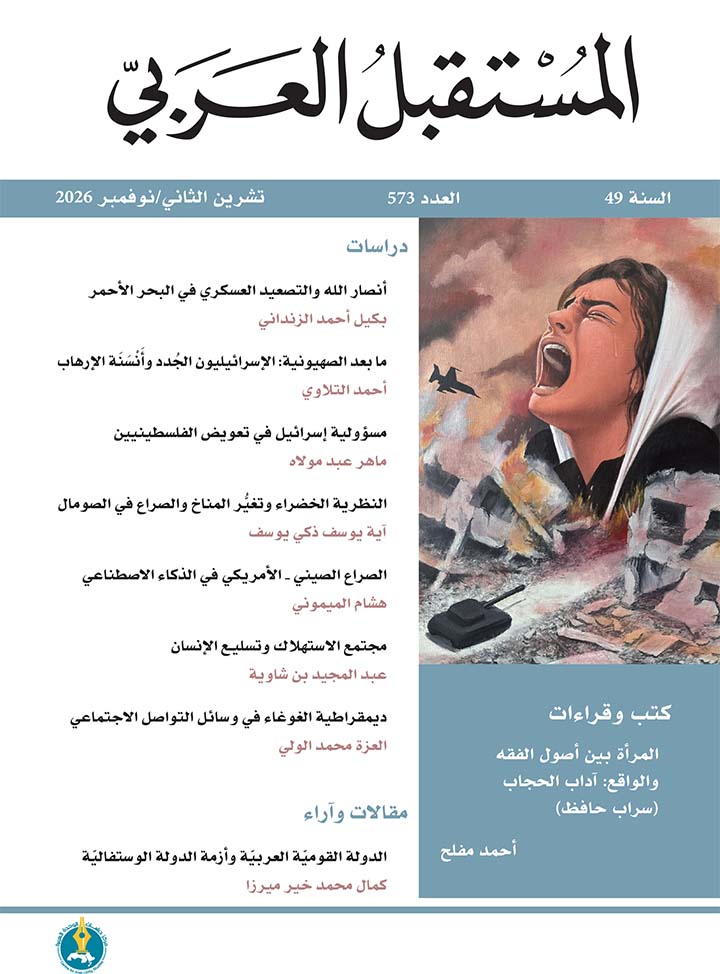
⬜ Ansar Allah and the American-Israeli Escalation in the
Red Sea Bakeel Ahmed Al-Zandani 7
https://doi.org/10.65506/261101
This study examines the transformation of the Red Sea, since late 2023, into a regional and international arena of conflict, in light of the escalation of maritime operations associated with the Yemen crisis and the repercussions of the war in Gaza, and the resulting expansion of military confrontation across the region. The study adopts an analytical approach based on the assumption that developments in the Red Sea reflect deeper transformations in the structure of regional conflict and the interconnected international interests related to energy security and global trade. The study concludes that the Red Sea is no longer merely a strategic shipping corridor; rather, it has become an active political and security arena contributing to the reshaping of power balances in Yemen and the Arab Levant.
Keywords: Red Sea, Regional Security Theory, Militarization of Maritime Chokepoints, Security Interdependence.
⬜ Post-Zionism: The New Israelis and the Trap of Humanizing
Terrorism! Ahmed Al-Tallawi 23
https://doi.org/10.65506/261102
This study sheds light on the post-Zionism movement, exploring its meaning, historical roots, and relationship with Zionism, as well as its connection to the Oslo process and other related phenomena, such as the New Historians, peace movements, and the meaning of the term «New Israelis» associated with this movement. The study examines the main tenets of this movement and their implications for Israel’s identity crisis. It also addresses several political developments in Israel since the Oslo Accords and their relationship to the growing dominance of the far-right religious-nationalist current in Israel’s party politics, political life, and parliamentary system. The study aims to highlight Israel’s aggressive and racist character, emphasizing the importance of understanding how Zionist propaganda exploits such phenomena to «humanize» the Zionist entity and conceal its crimes.
Keywords: Post-Zionism, New Historians, Oslo Accords, Palestinian Question, Zionism, Israel, the Israeli Question, Religious Nationalist Right in Israel.
⬜ Israel’s Responsibility to Compensate for Violations of
Palestinian Rights in the Aftermath of Operation
Al-Aqsa Flood Maher Abd Mouleh 42
https://doi.org/10.65506/261103
The Palestinians’ demand for compensation for the harm caused by Israel during the genocidal war against Gaza constitutes a legitimate right recognized under customary international law and all branches of contemporary international law governing state responsibility. The demand for compensation reflects a principled position: the Palestinians’ steadfast commitment to their rights, which brings back to the forefront the issue of compensation associated with the right of return following the 1948 war and then the 1967 war, as well as subsequent wars and events of no less significance. Thus, at a time when Israel seeks to erase the Palestinians through genocide, siege, starvation, and forced displacement, the Palestinians remain steadfast on their land, defending their rights and sacred sites despite the harassment, schemes, and disinformation practiced by the occupying power, with the support of domestic, regional, and international actors.
Keywords: Palestine, Israeli Occupation, Genocide, Right to Compensation, International Law.
⬜ Green Theory in International Relations: Climate Change
and Conflict in Somalia Aya Youssef Zaki Youssef 62
https://doi.org/10.65506/261104
Green theory is based on the assumption that a natural system exists in which humans are one component rather than its central focus, as human beings are part of a broader system of interconnected elements. In this regard, green theory examines the effects of climate change on conflicts. Although climate change may not directly cause conflict, it can contribute to increasing the risks associated with it. This applies particularly strongly to the case of Somalia, where climate change has affected resource scarcity, weakened state institutions, and contributed to the emergence of a fragile state. These conditions have, in turn, contributed to the growth of terrorism, as the Al-Shabaab militant movement has sought to adapt its strategies to changing circumstances in order to strengthen its dominance through territorial control.
Keywords: Green Theory, Climate Change, Resources, Conflict, Terrorism, Somalia.
⬜ The Sino-American Rivalry in Artificial
Intelligence Hisham El-Mimouni 78
https://doi.org/10.65506/261105
This study examines the dynamics of the Sino-American rivalry in the field of artificial intelligence, which aims to expand economic, military, and technological dominance. The study argues that artificial intelligence contributes to the development of intelligent military weapons, such as drones and robots; strengthens cybersecurity and defense capabilities; and increases global output and economic growth. It also supports decision-making and diplomacy in foreign policy through data analysis. Furthermore, artificial intelligence is a decisive factor in reshaping the international balance of power, shifting the basis of power from material capabilities to knowledge, while deepening the digital divide between countries. Consequently, artificial intelligence heralds a transformation in the nature of warfare and alliances. A wide range of countries are involved in this competition, most notably Russia and European countries, which are making substantial investments in the field.
Keywords: Artificial Intelligence, China, United States, Data Sovereignty, Sino-American Rivalry.
⬜ Consumer Society: Consumerist Frenzy and the Commodification of
Human Beings Abdelmajid Ben Chaouia 90
https://doi.org/10.65506/261106
The concept of «consumer society» has emerged as one of the most prominent contemporary phenomena to attract the attention of thinkers, intellectuals, and philosophers, given its far-reaching and detrimental consequences for individuals and societies around the world. It has sparked a wave of criticism directed
at prevailing realities, individual and collective behaviors, and social, political, economic, cultural, psychological, and scientific systems. Scholars have made this phenomenon a central focus of their reflections, studies, and critiques, particularly in light of the value-based, cultural, economic, social, scientific, and technological transformations produced by contemporary civilization, modernity, and postmodernity. These transformations have profoundly affected human beings, leaving them deprived of their free will and increasingly vulnerable to reification and commodification, while stripping them of their human values. As a result, they have been deprived of the happiness they aspire to and subjected to forms of enslavement imposed by market products, dominant powers, and technology.
Keywords: Consumer Society, Critique, Contemporary Civilizational System, Liquid Modernity, Loss of Free Will, Reification, Happiness, Market, Dominant Powers.
⬜ Mob Democracy in the Age of Social
Media El-Izzah Mohammed Al-Wali 109
https://doi.org/10.65506/261107
Democracy, as a system of governance, is one of the defining features of the modern state. Although this system generates considerable debate, particularly in light of policies that claim to embody democratic principles, it is generally viewed through the lens of reform rather than fundamental change. Individual freedoms continue to expand, and there appears to be little prospect of reversing this trend. This study seeks to examine the relationship between democracy and individual freedom in the age of social media. It explores several key issues, including the impact of technological developments and the diverse opportunities for expression they provide on systems of governance, elections, and even state stability. It also investigates the role of financial and technological «empires» in shaping both democracy and individual freedom.
Keywords: Mob Democracy, Democracy, Trending Crowds, Public Opinion Manufacturing, Populism.
⬛ Articles and Opinions
⬜ The Arab Nation-State and the Crisis of the
Westphalian State Kamal Mohammed Khair Mirza 125
https://doi.org/10.65506/261108
⬛ Books and Readings
⬜ Women Between the Principles of Islamic Jurisprudence and Reality:
The Etiquette of Hijab (Sarāb Hāfez) Ahmed Moufleh 145
https://doi.org/10.65506/261109
⬜ Selected Arabic and Foreign Books
and Research Reports GabyAl-Khoury 156
Arabic Books: Sorrows in a Turbulent World: Reflections and Memoirs; Education and the Future of the Gulf: The Imperative of Reform; Islam and Muslims in American Opinion Polls (1963–2023); Political Conditions in the Arabian Gulf During the Islamic Eras, 1–656 AH / 622–1258 CE.
Foreign Books: Chinese Soft Power in the Middle East: Mechanisms, Effectiveness, and Strategic Implications; Great Power Politics, Elites and Energy; The Arab State after the Uprisings: Theoretical and Empirical Reverberations; The Shah’s Party and the Iranian Revolution That Followed.
Research Reports: «The Latest Cycle of Saudi-Houthi Escalation Is Different-and More Dangerous»; «The Victory of Asymmetry in the Iran War».
Add a review
You must be logged in to post a review.
You May Also Like
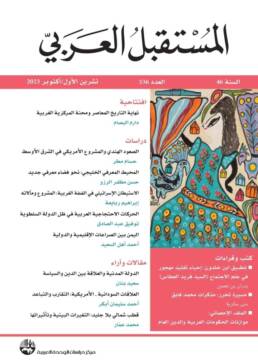
The ARAB FUTURE (AL MUSTAQBAL AL ARABI), No. 536, October 2023
Price range: 2 $ through 3 $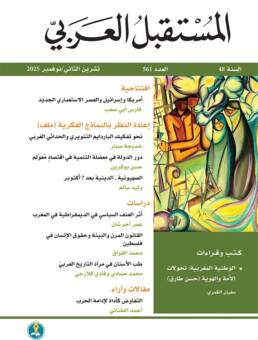
The ARAB FUTURE (AL MUSTAQBAL AL ARABI), No. 561, November 2025
Price range: 2 $ through 3 $
The ARAB FUTURE (AL MUSTAQBAL AL ARABI), No. 551, January 2025
Price range: 2 $ through 3 $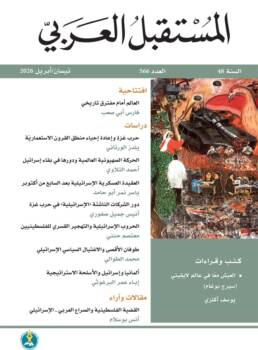
The ARAB FUTURE (AL MUSTAQBAL AL ARABI), No. 566, April 2026
Price range: 3 $ through 5 $
The ARAB FUTURE (AL MUSTAQBAL AL ARABI), No. 545, July 2024
Price range: 2 $ through 3 $
The ARAB FUTURE (AL MUSTAQBAL AL ARABI), No. 558, August 2025
Price range: 2 $ through 3 $