
Editorial
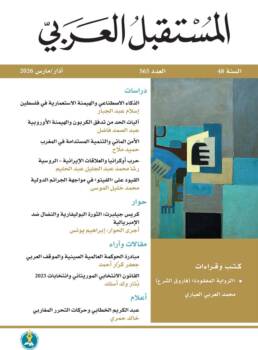
⬜ The world stands at a historic crossroads Fares Abi Saab 7
https://doi.org/10.65506/30301
⬛ Studies
⬜ Gaza War: Reviving the Logic of Colonial Centuries
in International Law Yildiz Al-Wartani 13
https://doi.org/10.65506/30302
Colonialism was not merely a passing chapter in history; rather, it constituted the foundational structure upon which international law was built from its very inception. The development of this body of law was closely tied to the trajectory of European imperial expansion, and it was shaped as a tool to regulate relations among dominant powers and to justify their control over colonized peoples.
This study seeks to examine the war that erupted in Gaza following October 7 through a colonial historical lens, as ignoring the roots of this war and overlooking its broader historical framework risks legitimizing the delegitimization of Palestinians and rendering them invisible within dominant narratives. This reading adopts a historical perspective in order to understand Palestinian suffering as the result of an enduring colonial structure, rather than as a series of isolated incidents.
Keywords: Gaza, October 7, international law, imperialism, just war, self-defense, war on terror, civilizational superiority, self-determination, British Mandate, Balfour Declaration, settler colonialism.
Institutions of the Global Zionist Movement and
Their Role in the Survival of Israel Ahmed Al-Talawi 29
https://doi.org/10.65506/30303
This study provides an in-depth examination of the roles played by the global Zionist movement and its institutions in supporting Israel and ensuring the state’s survival, including the backing of its military and security institutions. This support is facilitated through the movement’s wide global presence, particularly in the United States and the countries of the British Commonwealth.
The study explores several examples of institutions and companies that support Israel in both times of peace and war, as well as the coordinating role of the «World Zionist Organization.» It also discusses the role of Jewish financiers in influencing both traditional and digital media, and in shaping Western public opinion to serve Israel’s interests.
Additionally, the study sheds light on the historical roots of Jewish efforts to establish a national homeland in Palestine, tracing these attempts back to the period preceding the First Zionist Congress in 1897.
Keywords: Zionist movement, World Zionist Organization, Jewish national homeland, Gaza War.
⬜ The Israeli Military Doctrine After October 7, 2023
Yasser Nimr Abu Hamed 50
https://doi.org/10.65506/30304
This study examines the fundamental transformations in Israel’s renewed military doctrine in the aftermath of October 7, 2023. It seeks to anticipate the expected outcomes of the application of this updated doctrine at both the Palestinian and Arab levels, through an analysis of its components and its field implementations.
The study reaches several conclusions, most notably that this doctrine has led to a prolonged escalation across conflict arenas, an increase in humanitarian and civilian costs, a rise in security threats, and growing international isolation of the occupation.
It also presents a set of recommendations, foremost among them the need to rebuild the Palestinian national project, establish unified leadership, activate legal and diplomatic tools at the international level, and restore the Palestinian cause to a central position on the Arab agenda.
Keywords: transformations, military doctrine, occupation army, October 7, 2023 war, Palestinian cause, national project.
⬜ Militarization of the Middle Class: The Role of
«Israeli» Startups in the Gaza War Anis Jamil Safouri 69
https://doi.org/10.65506/30305
This paper examines the role of «Israeli» startups in the war of genocide against the Palestinian people in Gaza since October 2023. It argues that these companies, largely rooted in the middle class, contribute to the development of advanced military and security technologies, such as drones and artificial intelligence.
The study relies on various analytical methodologies, including Marxist theory, to understand the intersection between economics, politics, and security. It also highlights how the «Israeli» government supports these companies through funding and military contracts, thereby reinforcing their role in the conflict.
In addition, the paper discusses the economic and social impact of these companies, as well as the future demographic challenges that «Israel» may face due to the lack of diversity in its technology workforce.
Keywords: Israeli startups, war of genocide against Palestinians, military and security technology, middle class in Israel.
⬜ Israeli Wars and the Forced Displacement of
Palestinians from Their Land Motasem Hanani 86
https://doi.org/10.65506/30306
Since the late nineteenth century, the Zionist project has relied on policies of forced displacement and settlement to reshape the demographic reality in Palestine. Despite the success of the Zionist project and the State of Israel in displacing large numbers of Palestinians during the Nakba of 1948 and the 1967 war, the state continues to face political and demographic obstacles that prevent the achievement of comprehensive displacement of Palestinians.
In the context of the ongoing war on Gaza, Israel has adopted a new approach based on the destruction of infrastructure and the creation of harsh living conditions aimed at forcing Palestinians to leave the Strip. These policies coincide with international political pressures, most notably calls by U.S. President Donald Trump to relocate Gaza’s population to neighboring countries.
Keywords: Israel, forced displacement, Gaza, Palestinian demography, Donald Trump, international challenges.
⬜ Al-Aqsa Flood and Israeli Political Assassination
Mohammed Al-Touali 103
https://doi.org/10.65506/30307
Several months after the war that followed Al-Aqsa Flood, the Zionist entity began employing political assassination as a tool to target the political and military leadership of resistance movements across the region without limits. It carried out assassinations of prominent leaders, political and military figures, and negotiators in countries such as Iran, Lebanon, Yemen, and Qatar—whether through direct aggression or special operations that violate state sovereignty.
This study seeks to analyze and evaluate the objectives, impacts, and outcomes of this policy of political assassination adopted by the Zionist entity, and to explore possible ways of addressing it. The study concludes that this policy has not been strategically effective in achieving the entity’s goals, and that its impacts have remained limited.
Keywords: political assassination, Al-Aqsa Flood, October 7, Hassan Nasrallah, Ismail Haniyeh, Yahya Sinwar, Zionist entity.
⬜ Germany and Israel and Strategic Weapons:
The Nuclear Submarine Deal Ibaa Omar Al-Barghouthi 122
https://doi.org/10.65506/30308
This study addresses the special and complex relations between Germany and Israel in the field of strategic weapons, particularly the «Dolphin» nuclear submarine deal. These relations are based on historical backgrounds, most notably the sense of guilt stemming from the Holocaust, Germany’s commitment to Israel’s security, and the balance of power in the Middle East. The study focuses on the influence of cultural, political, and technological factors in decision-making, with an analysis of Israel’s nuclear role and the security cooperation between the two countries. This relationship strengthens Israel’s defense capabilities, despite internal German challenges related to human rights and regional policy. The significance of this relationship is evident in regional security balance and deterrence strategies, with its broader impact on regional policies and security in general.
Keywords: Germany, Israel, submarine deal, Holocaust, balance of power, strategic cooperation, precision technology, colonial tendencies.
⬛ Articles and Opinions
⬜ Reflections on the Palestinian Cause and the Arab–Israeli
Conflict (Serge Paugam) Anas Bouslam 137
https://doi.org/10.65506/30309
⬛ Books and Readings
⬜ Living Together in a World of Uncertainty
(Serge Bogam) Youssef Agoulzi 153
https://doi.org/10.65506/30310
⬜ Selected Arabic and Foreign Books and Research
Reports Gaby El-Khoury 160
Arabic Books: Trump’s Promise: The Embodiment of Greater Israel; Death of the Intellectual: Representations of the Intelligentsia in the Novel Narrative; Security in International Relations: From the State to the Individual – Towards a Comprehensive Approach; The Secret of Yasser Arafat: Israeli Perspectives
Foreign Books: Gaza: The Dream and the Nightmare; Democracy at the Crossroads: Challenges for Governance and Representation Essays in Honour of Thomas Saalfeld; Israel, the United States, and the Antagonistic Identification of Iran; Neocolonialism Re-presenting Narratives, Realities and Responses.
Research Reports: «Why Are China and Russia Not Rushing to Help Iran?,» and «The Strait of Hormuz: A U.S.-Iran Maritime Flash Point».

Add a review
You must be logged in to post a review.
You May Also Like

The ARAB FUTURE (AL MUSTAQBAL AL ARABI), No. 555, May 2025
Price range: 2 $ through 3 $
The ARAB FUTURE (AL MUSTAQBAL AL ARABI), No. 527, January 2023
Price range: 2 $ through 3 $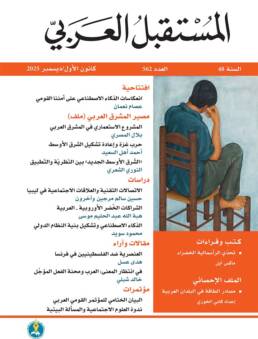
The ARAB FUTURE (AL MUSTAQBAL AL ARABI), No. 562, December 2025
Price range: 2 $ through 3 $
The ARAB FUTURE (AL MUSTAQBAL AL ARABI), No. 563, January 2026
Price range: 3 $ through 5 $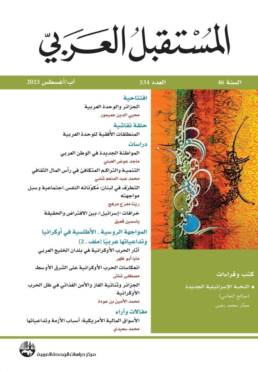
The ARAB FUTURE (AL MUSTAQBAL AL ARABI), No. 534, August 2023
Price range: 2 $ through 3 $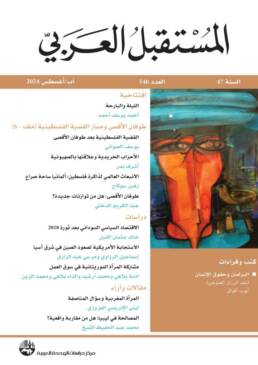
The ARAB FUTURE (AL MUSTAQBAL AL ARABI), No. 546, August 2024
Price range: 2 $ through 3 $