

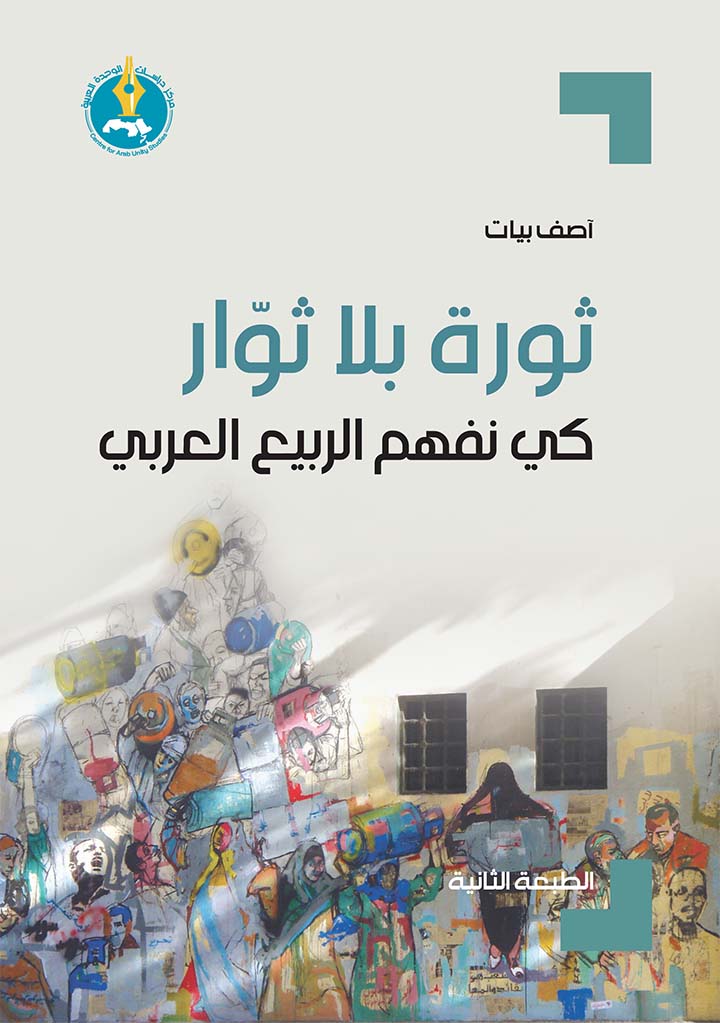
Revolution without Revolutionaries: Making Sense of the Arab Spring
Price range: 10 $ through 18 $
Price range: 10 $ through 14 $
AuthorAsef Bayat (translated by Victor Sahab)Date12/1/2026No. of Pages350EditionSecondISBN978-614-498-437-6E-ISBN978-614-498-438-3
| Weight | 0,520 kg |
|---|---|
| Dimensions | 24 × 17 cm |
| Product Type | Electronic, Paper |
The Center for Arab Unity Studies published the second edition of the book Revolution without Revolutionaries: Making Sense of the Arab Spring by researcher Asef Bayat (translated by Victor Sahab).
People may or may not know about the revolution, until it happens. This is because the occurrence of a revolution has little to do with any ideas, and it has less to do with a “theory” of the revolution. Revolutions happen simply. But having an idea of a revolution, or a lack of an idea of it, has crucial consequences for the outcome of the revolution when it actually occurs. This book examines revolutions without “revolutionary ideas”, revolutions that have adapted to the conditions of our neoliberal times. The book focuses on the Arab Spring, and those amazing revolutionary uprisings that took place in the political arena at a time when, ironically, the idea of the revolution itself was excluded. Therefore, the book is not just a novel of the Arab Spring, nor is it a presentation of current events, but rather its central purpose is to explain these exceptional political events, especially in Tunisia and Egypt, in order to understand their dynamics, analyze the processes of mobilizing them, examine their contradictions, and shed light on their promises, from the perspective of A comprehensive, historical and comparative view. The book somewhat details the actual processes in these revolutions, but it is also a book on social theory, and a modest attempt to introduce terms and shed light, in order to better understand these political events. But the book in the end was not the result of study and writing in a specific time; Rather, its information, visions, and conceptual structure are based on many years of thinking about the issue of social and political development in the Muslim Middle East, many years before the 2011 uprisings, when the author was living and teaching in Cairo.

Add a review
You must be logged in to post a review.
You May Also Like

Saudi Policy towards Yemen after the Popular Uprising 2011
Price range: 6 $ through 10 $

Orientalism and Hegemony: Colonial Discourse and the Domination over the Arab East
Price range: 10 $ through 11 $
Council of Nation of Algeria: Its Representative Dimensions and Role in Institutional Stability
Price range: 8 $ through 13 $
Contradictions in International Law An Introductory Analysis
Price range: 8 $ through 13 $

Sorrows in a Turbulent World: Reflections and Memoirs
Price range: 10 $ through 10 $
Theories of International Relations: From Elaboration to Global Critical
Price range: 10 $ through 13 $
The State of the Arab Nation, 2017-2018: A Year of Hope and Risk
Price range: 5 $ through 8 $