
Studies
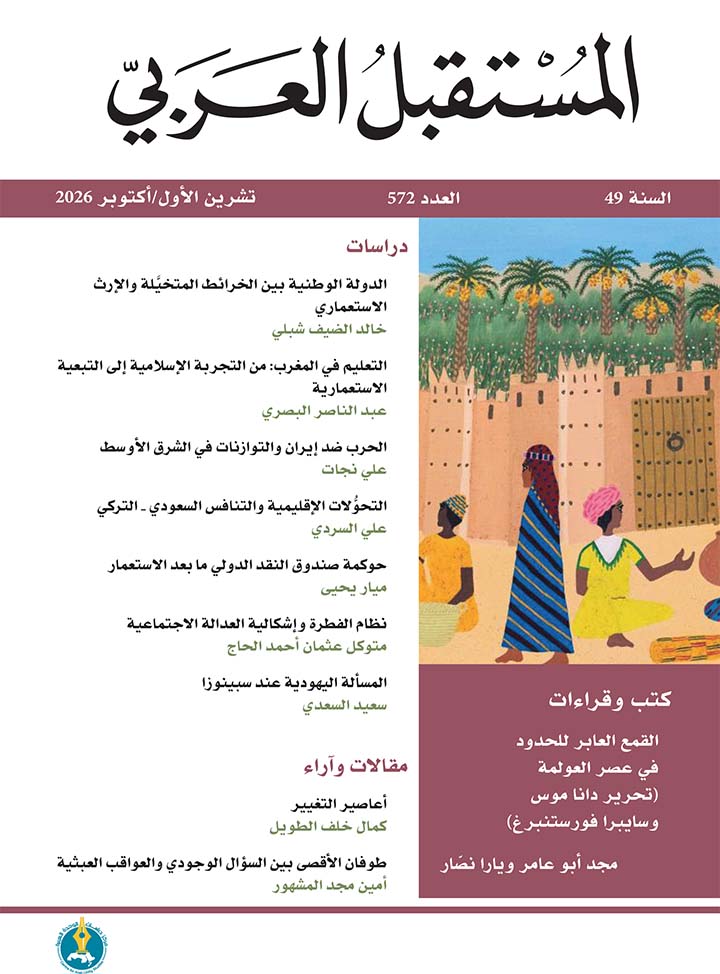
⬜ The National Arab State: Between Imagined Maps and the
Legacy of Settler Colonial Partition Khaled Al-Deif Shibli 7
https://doi.org/10.65506/261001
The Arab national state is no longer merely a legal framework for sovereignty; rather, it has transformed into an open-ended question regarding its borders, the legitimacy of its identity, and its capacity to generate political action. This study approaches the state as a complex construct shaped under the influence of imagined maps and the legacy of colonial, settler-oriented partition. This historical process has produced a persistent gap between legal borders and actual social extensions. The article analyzes this tension as a primary source of the crisis of sovereignty and the fragility of political belonging, wherein citizenship becomes a procedural bond rather than a substantive, actual integration. Furthermore, it explains the persistence of deferred political action as the product of an incomplete constitutional structure, proposing the possibility of reimagining the state within a flexible model that accommodates pluralism and reconnects the law with society.
Keywords: The Arab National State, Constitutional Sovereignty, Political Belonging, Citizenship, Imagined Maps, Political Systems, Political Sociology, Post-colonialism.
⬜ The Formation of Education in Morocco: From the Islamic
Experience to Colonial Dependency Abd al-Nasser al-Basri 25
https://doi.org/10.65506/261002
This study seeks to re-read the historical trajectory of science and education in Morocco, tracing its shift from an active, pivotal position within the broader Islamic experience to its current state as part of an educational system suffering from a deep alienation from its scientific and cultural roots. The study highlights Morocco’s role in constructing the sciences of the universe and humanity through its ancient scholarly institutions, demonstrating how a cognitive paradigm was formed that synthesized revelation, reason, and empirical experience. Furthermore, the study deconstructs the prevalent narrative in contemporary Arab consciousness regarding the «conflict between religion and science,» revealing the European origins of this narrative and showing how its adoption in school curricula has produced a «historical alienation» among Moroccan students, severing their connection to their own scientific history. Finally, the study examines the phase of internal contraction and colonial education in Morocco.
Keywords: History of Science, Colonial School, Arabization, Francization, Educational Policies, Cognitive Independence, Scientific Renaissance.
⬜ The American-Israeli War Against Iran and the Future of
Balances in the Middle East Ali Najat 47
https://doi.org/10.65506/261003
This study examines the impacts of the American-Israeli war against Iran on reshaping regional balances in the Middle East, analyzing how the war contributed to the reconfiguration of regional alliances and strategic balance patterns in the region. The study posits that the war served as a major catalyst for regional realignment, leading to the emergence of new security and political arrangements based on shared strategic interests rather than traditional ideological considerations. Furthermore, the study indicates that the region is heading toward a more pluralistic and complex regional structure, wherein emerging alliances compete for influence, resources, and strategic corridors, amid the growing importance of economic, technological, and military power elements in shaping the features of the new regional order.
Keywords: The American-Israeli War Against Iran, Regional Balances, Regional Alliances, Regional Security, Regional Order, Middle East.
⬜ Regional Transformations and Their Impact on
Saudi–Turkish Rivalry Ali Al-Sardi 64
https://doi.org/10.65506/261004
Middle East crises stimulate strategic rivalry among regional powers. The Saudi–Turkish rivalry serves as a prime model of this phenomenon, emerging most prominently on the Syrian stage, where the domestic crisis was leveraged in regional and international conflicts and projects, leading to consequences that culminated in the fall of the Syrian regime. This study examines the nature and dynamics of Saudi–Turkish rivalry in light of the transformations sweeping the Arab region following the fall of the Syrian regime, as these regional shifts in the Middle East have driven both Saudi Arabia and Turkey to adopt competitive policies to exploit these changes to enhance their regional standing and influence. This study analyzes the dynamics of rivalry between the two countries and the intervention policies pursued in several countries in the region.
Keywords: Saudi–Turkish Rivalry, Transformations in the Middle East, Turkish Ambitions in the Region, The Syrian Stage.
⬜ The International Monetary Fund’s Governance Model:
Post-Colonialism as a Case Study Mayar Yahya 80
https://doi.org/10.65506/261005
This study presents a critical reading of the International Monetary Fund (IMF) and its governance model. It draws on the discipline of International Relations, utilizing Neorealist and Neoliberal perspectives on one hand, and critical approaches—namely Neo-Gramscianism, Post-colonialism, and Critical Feminism—on the other, with a specific focus on the post-colonial framework. The paper explores the diverse theoretical and intellectual currents within this field, analyzing the Fund’s governance model and the operationalization of the principle of participation. Furthermore, the study proposes alternatives aimed at deconstructing the colonial structure within the organization to make it more representative of developing nations’ interests, thereby enhancing their capacity to negotiate with the Fund on fateful decisions that directly impact the lives of their peoples.
Ultimately, the study underscores the necessity for the Fund to implement structural and policy reforms.
Keywords: IMF, Governance, Post-colonialism, Voting Power, Western Hegemony.
⬜ Innate Human System and the Dilemma of Social Justice in the
Era of Capital and Debt Mutawakil Osman Ahmed Al-Haj 104
https://doi.org/10.65506/261006
This study examines the problematic of social justice from the perspective of the relationship between humans, resources, and the means of accessing them. It proceeds from the hypothesis that many of the crises facing contemporary societies cannot be explained by the scarcity of resources alone; rather, it is essential to analyze the very structure that organizes access to these resources and determines the conditions for their utilization. The study argues that the contemporary global economic system, despite its diverse political and institutional forms, has historically evolved within the process of capital accumulation. Furthermore, tools such as debt, credit, banks, and financial markets have become central elements in organizing economic and social activity. These tools are no longer merely technical means of financing, but have instead become mechanisms that actively influence the distribution of power, opportunities, and decision-making.
Keywords: System of Fitrah, Social Justice, Structural Inequality, Capital, Debt, The Course, Human Dignity, Access to Resources.
⬜ The Jewish Issue according to Spinoza Said Al-Saadi 120
https://doi.org/10.65506/261007
Following the rise of nationalism in nineteenth-century Europe, Jewish communities found themselves dispersed, revealing that the concept of a Jewish nation was more imagined than real. This study examines Jewish political thought, which Spinoza transformed from a framework bound to the Jewish community or people into one centered on the civil state and citizenship. In doing so, he bypassed medieval Rabbinic thought—primarily represented by Maimonides and Al-Fayyumi—and passed the torch to Moses Mendelssohn, who founded the Jewish Enlightenment (Haskalah) to integrate Jewish individuals into society and the state, freeing them from any racial exceptionalism. This trajectory continued until the Jewish Enlightenment was fatally struck by the Zionist movement, which brought repressed conflicts back to the surface in the wake of tragic events experienced by Jewish populations in Europe.
Keywords: Spinoza, Moses Mendelssohn, Judaism, Rabbinism, The State, Enlightenment, Zionism.
⬛ Articles and Opinions
⬜ Typhoons of Change Kamal Khalaf AlTawil 130
https://doi.org/10.65506/261008
⬜ Al-Aqsa Flood between the Existential Question and the
Absurd Consequences Ameen Majd Al Mashour 144
https://doi.org/10.65506/261010
⬛ Books and Readings
⬜ Transnational Repression in the Age of Globalization (Dana Moss
and Saipira Furstenberg (eds.)) Majd Abu Amer & Yara Nassar 152
https://doi.org/10.65506/261009
⬜ Selected Arabic and Foreign Books
and Research Reports GabyAl-Khoury 159
Arabic Books: Ideas and Opinions on National Concerns (1): On Politics; From Knowledge to Worldview: The Debate of Conceptions Between the Qur’an and the Contemporary West; Arab Women in Wars: Suffering and Empowerment.
Foreign Books: Germany Rearmed: The Return of War and the End of Illusions; Israel’s Lobby: America in the Grip of a Foreign Power; Russian Military Interventions after the Cold War: Evaluating the Russian Federation’s Wars.
Research Reports: «Settlements Trade Ban: Europe and Israel on a Collision Course Over the West Bank» and «Amid Iran War Tensions, Energy Market Resilience Wears Thin».
Add a review
You must be logged in to post a review.
You May Also Like
The ARAB FUTURE (AL MUSTAQBAL AL ARABI), No. 565, March 2026
Price range: 3 $ through 5 $
The ARAB FUTURE (AL MUSTAQBAL AL ARABI), No. 542, April 2024
Price range: 2 $ through 3 $
The ARAB FUTURE (AL MUSTAQBAL AL ARABI), No. 546, August 2024
Price range: 2 $ through 3 $
The ARAB FUTURE (AL MUSTAQBAL AL ARABI), No. 551, January 2025
Price range: 2 $ through 3 $
The ARAB FUTURE (AL MUSTAQBAL AL ARABI), No. 560, October 2025
Price range: 2 $ through 3 $
The ARAB FUTURE (AL MUSTAQBAL AL ARABI), No. 530, April 2023
Price range: 2 $ through 3 $