

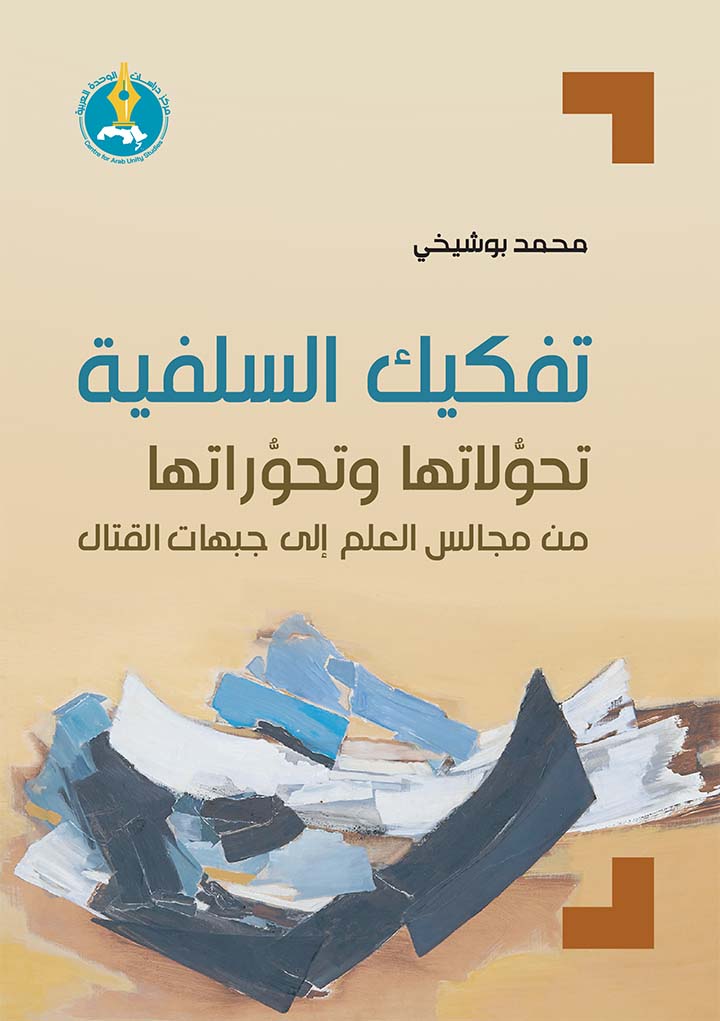
Deconstructing Salafism It’s Transformations and Modifications From Scholarly Assemblies to Battlefields
Price range: 10 $ through 18 $
Price range: 10 $ through 14 $
AuthorMohamed BouchikhiDate30/9/2025No. of Pages448EditionFirstISBN9786144984154E-ISBN9786144984161
| Weight | 0,665 kg |
|---|---|
| Dimensions | 24 × 17 cm |
| Product Type | Electronic, Paper |
The Center for Arab Unity Studies published the book Deconstructing Salafism: It’s Transformations and Modifications From Scholarly Assemblies to Battlefields by Dr. Mohamed Bouchikhi.
The “Albanian” movement, named after Sheikh Muhammad Nasir al-Din al-Albani, represented a strong shock to the established principles of traditional Salafism, by reviving the doctrine of the early “hadith” scholars, which was based on rejecting sectarianism, prohibiting imitation, adopting the literal interpretation, and then raising the Sunnah to the level of the Qur’an. “Qutbism,” named after Sayyid Qutb, also represented a revolution against Salafist “narratives” and Brotherhood “pragmatism,” by creating a transformative approach based on “the correlation between activist growth and theoretical growth” as a basic rule and sub-rules represented by “rejecting jurisprudence,” “jihad as a producer of jurisprudence,” and then “the gradual implementation of Sharia rulings.”
While “Albanism” achieved a kind of congruence with “Qutbism” at the level of analyzing reality and similarity at the level of changing it; the congruence at the level of analysis was represented by Albanian borrowing the concepts of “ignorance”, “sovereignty”, and “separation”, and surrounding them with a Salafist touch. As for the similarity at the level of change, it was embodied in al-Albani’s adoption of a revolutionary concept of the “victorious sect,” which aligned with Qutb’s concept of the “unique Quranic generation.” This convergence and similarity encouraged jihadist activists to adopt the Albanian methodology in dealing with the Sunnah, thus crystallizing the first beginnings of the “hybridization” processes that formed “Salafist jihadism.”
With the interaction of the jihadist idea with Islamic jurisprudence, after it had been confined to ideological literature, Salafist references expanded and the jihadist movement moved from the activist form to the Salafist form. However, the difference between the two main components of Salafist Jihadism, Albanian Salafism and Qutbist activism, has necessitated conflict between its legitimate leaders who are inclined towards Salafism and its field leaders who are compliant with Qutbism, after the jihadist became “his own jurist” underestimating legitimate knowledge and in conviction of the saying “a sitting person does not issue a fatwa for a mujahid.”

Add a review
You must be logged in to post a review.
You May Also Like

The Arab Lobby and the US: Factors for success and Failure
Price range: 7 $ through 10 $

Comprehending the Judicious Qur’an: A Clear Exegesis According to the Sequence of Revelation (Part Three)
Price range: 10 $ through 12 $

Social Movements and Political Parties: Political Islam in Egypt, Tunisia, and Morocco
Price range: 8 $ through 13 $
Development at the Margins of the Gulf
Price range: 7 $ through 11 $

Muslim Women: Social Realities and Legal Rules
Price range: 9 $ through 14 $

Women in Arts and Media: From Stereotyping to Change
Price range: 8 $ through 13 $
The Logic of Power : An Introduction to the Philosophy of Order
Price range: 11 $ through 18 $