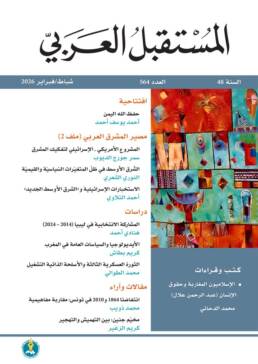

Studies
⬜ Red Canaanites: An American Laboratory for the
War of Palestinian Genocide Munir Al-Akash 7
https://doi.org/10.65506/260501
With the escalating racist, expansionist, and aggressive tendencies of Israel in the region—taking on a criminal trajectory that has reached the level of genocide in Gaza—questions persist about the meaning of Western, particularly American, support for this trajectory, despite all the liberal and Enlightenment claims upheld by the West. This study examines the intellectual, doctrinal, and cultural frameworks prevailing in the West, especially in the United States, which explain this American and Western support for Israel despite the crimes it commits. The study traces these frameworks back to biblical references that underpin narratives justifying Israel’s right to Palestine—references that had previously served as the ideological background for justifying the extermination of Indigenous peoples in America and the establishment of a settler state on their ruins.
Keywords: Israel, Genocide, Torah, Native Americans, Western Culture.
⬜ The Digital Transition of the Arab Elite: Growing Up
on Rival Platforms Ali Ghouaidia 35
https://doi.org/10.65506/260502
Digitalization has acted as an ill omen for the elite, as online platforms—particularly social media—have leveled the field between «hordes of fools» and «a Nobel Prize winner» in terms of the «right to speak.» Nevertheless, the elite still exists and has, in fact, become «more elitist,» while the popular has become «more pop ular.» Amid the media-driven celebrity culture fostered by online platforms—and the shift in selection criteria from intellectual merit and productivity to «highest view count»—intellectual elites have tactically retreated to reclaim their (elite) roles, albeit in new forms. In light of this technological shift, intellectual elites are expected to reassess their social position and preserve, as much as possible, their cultural capital.
Keywords: Israel, Genocide, Torah, Native Americans, Western Culture, Digitization, Social Media, Internet, Arab Elites, Social Resistance.
⬜ The Traps of «Neoliberal» Economic Policies:
Oil Rent and Dollar Rent Sabri Zayer Al-Saadi 49
https://doi.org/10.65506/260503
This study argues that contemporary capitalist economic theory and the neoliberal economic policies derived from it are not always qualified or successful enough to be granted absolute professional and theoretical confidence in sustaining economic growth, creating employment opportunities, improving the welfare of people and societies, and accumulating national wealth. The economic, social, and political realities of states and societies do not always align with these policies. This is evident in the attempt to address the chronic structural economic crisis in Iraq’s «weak» economy through reliance on oil export rents, contrasted with efforts to address crises in the highly advanced U.S. economy through reliance on dollar rent. Attempts to temporarily manage these crises through «manipulative» or patchwork measures to repair fiscal and monetary policy are unlikely to significantly mitigate the underlying causes of these emerging crises.
Keywords: Capitalism, neoliberalism, Iraqi economy, oil rent, U.S. economy, dollar rent.
⬜ Egyptian Cyber Capabilities and the Cybersecurity Strategy (2030)
Ahmed Abdel Ghaffar Al-Essawi & Mona Hany Mohamed 65
https://doi.org/10.65506/260504
This study analyzes Egypt’s cyber capabilities and the role of artificial intelligence in their development within the framework of Egypt’s Cybersecurity Strategy 2030. It explains how the Egyptian state has leveraged AI technologies to build early warning mechanisms for cyberattacks and predictive analytics systems capable of supporting decision-makers in confronting digital threats. The study also highlights the central role of national research centers in developing indigenous solutions based on intelligent algorithms to strengthen cyber defenses. It concludes that integrating AI into cyber infrastructure represents a strategic step toward achieving digital sovereignty, and that investment in scientific research and specialized education is a fundamental pillar for safeguarding Egypt’s national security in the digital age.
Keywords: Cyber capabilities, artificial intelligence, research centers, national security.
⬜ Algeria and South Africa’s Support for the Palestinian Cause: Paths
of Colonialism and Narratives of Struggle Mostafa Bousboua 84
https://doi.org/10.65506/260505
This study examines the reasons behind Algeria and South Africa’s support for the Palestinian cause, tracing it back to the early years of anti-colonial struggle in both countries. This support became especially evident after October 7 and the subsequent acts of genocide in Gaza. The study shows that this support stems, first, from the colonial projects experienced by all three contexts, which intersect at the level of colonial discourse that justified them—through the dehumanization of the «other» to legitimize their extermination and segregation. Second, it highlights the solidarity that existed among colonial projects themselves, and third, the solidarity among liberation movements in Algeria, South Africa, and Palestine. This has led Algeria and South Africa to adopt narratives of struggle that have produced identities opposed to colonial projects.
Keywords: Settler colonialism, apartheid system, narratives of struggle.
⬜ Virtue in the Age of Cloud Capital:
Toward a Renewed Ethical Sphere Abdelrahman Azzi 104
https://doi.org/10.65506/260506
This text addresses the organic relationship between the form and substance of virtue, drawing on ethical epistemological thought within the context of post-industrial and emerging societies. It takes the virtue of justice as a lens to understand this relationship, which can be either interconnected or disconnected. This dynamic gives rise to an ideology of material gain and deepens class disparities both locally and globally, especially with the emergence of cloud capital as a new form of production and commercial accumulation. This, in turn, pushes society into a «zone of void,» where meaning in social, economic, and political life diminishes. The text proposes reconnecting virtue with both its form and lived substance in a renewed and conscious way within contemporary society.
Keywords: Virtue, form and substance, cloud capital, justice, inequality, zone of void, material ideology, renewed ethical thought.
⬜ Digital Participation and the Post-Human Condition: Transformations
of Political Action in Digital Space Othman Sahban 120
https://doi.org/10.65506/260507
This article examines the transformations of political action in digital space in light of the «post-human» thesis and the philosophical and political questions it raises. The digital condition—shaped by technological revolution and artificial intelligence—can no longer be reduced to neutral or intermediary tools; rather, it has become an active structural force reshaping the relationship between the individual and authority. It calls for a reconsideration of classical political concepts such as participation, citizenship, and democracy. The article questions the nature of the political actor in a context where human and machine roles intersect, showing how digital participation moves beyond individual practice to become an influential collective force capable of reshaping the public sphere and generating new forms of power.
Keywords: Digital political participation, post-humanism, digital democracy, artificial intelligence, post-human democracy.
⬛ Articles and Opinions
⬜ The Geopolitical Importance of the
Strait of Hormuz for Iran Ali Qassem Miqdad 138
https://doi.org/10.65506/260508
⬛ Books and Readings
⬜ Fragility and Health in Morocco (Abdelmoneim Abousaad &
Mohamed Cherkaoui) Rachid Amchnouk 149
https://doi.org/10.65506/260509
⬜ Selected Arabic and Foreign Books and Research
Reports Gaby El-Khoury 158
Arabic Books: Orientalism and Hegemony: Colonial Discourse and Control over the Arab East; Iraqi–Iranian Relations Amid Transformations: Future Visions for Constructive Relations; Islamic–Christian Associations: A Chapter from the History of the Palestinian National Movement (1918–1935); Freedom of Religion and Belief in Regional Transformations: Voices from Southwest Asia and North Africa
Foreign Books: Saudi Arabia’s Transformation: Uncertainty and Sustainability; Secularization, Social Order, and World History: Toward a Global Perspective; The Doom Loop: Why the World Economic Order Is Spiraling into Disorder
Research Reports: «The Fragile U.S.-Iran Ceasefire: Issues to Watch,» and With Hormuz Closed, China Is Wiring the Globe’s Clean Energy Future».

Add a review
You must be logged in to post a review.
You May Also Like
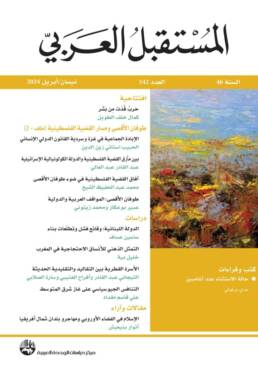
The ARAB FUTURE (AL MUSTAQBAL AL ARABI), No. 542, April 2024
Price range: 2 $ through 3 $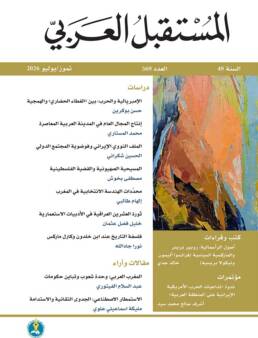
The ARAB FUTURE (AL MUSTAQBAL AL ARABI), No. 569, July 2026
Price range: 3 $ through 5 $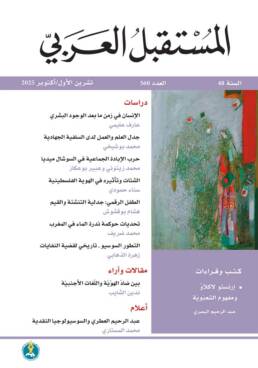
The ARAB FUTURE (AL MUSTAQBAL AL ARABI), No. 560, October 2025
Price range: 2 $ through 3 $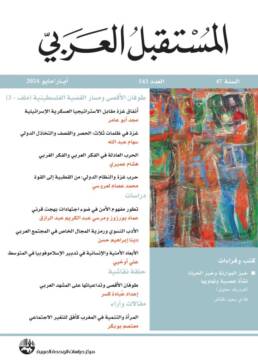
The ARAB FUTURE (AL MUSTAQBAL AL ARABI), No. 543, May 2024
Price range: 2 $ through 3 $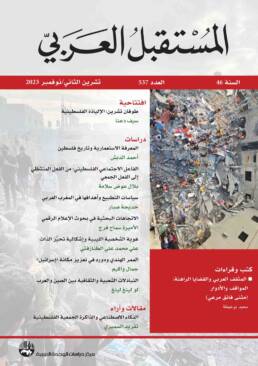
The ARAB FUTURE (AL MUSTAQBAL AL ARABI), No. 537, November 2023
Price range: 2 $ through 3 $
The ARAB FUTURE (AL MUSTAQBAL AL ARABI), No. 558, August 2025
Price range: 2 $ through 3 $