Editorial
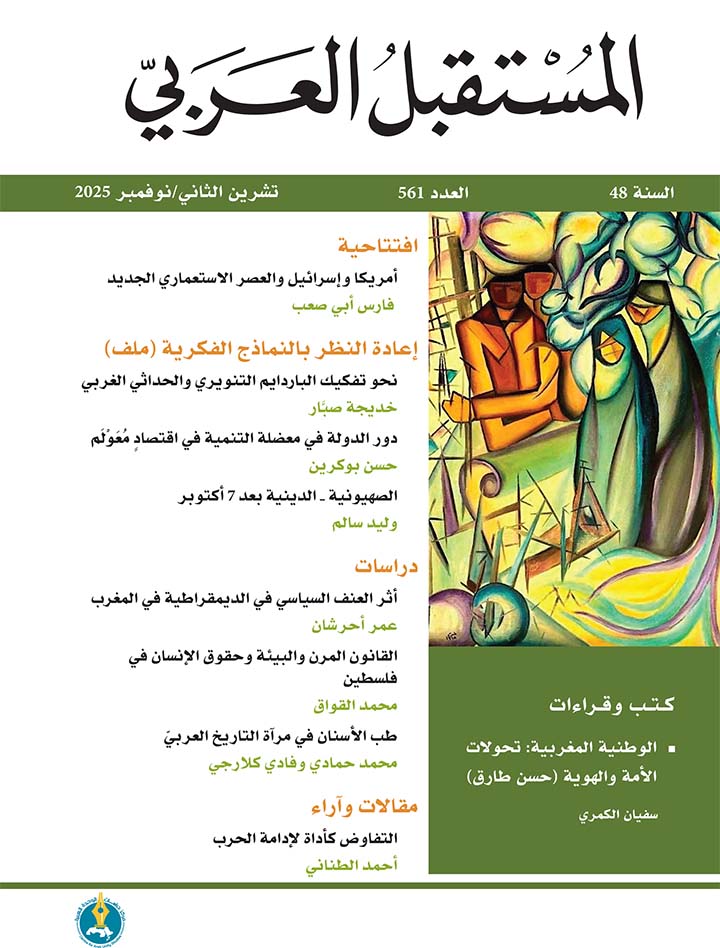
⬜ America, Israel, and the New Colonial Era Fares Abi Saab 7
⬛ Reconsidering Intellectual Paradigms (File)
⬜ Toward Deconstructing the Western Paradigm of Enlightenment
and Modernity Khadija Al-Sabbar 13
This study analytically reconsiders the colonial legacy in all its epistemic, socio-historical, and civilizational dimensions, as a reality we have inherited along with its values and conceptual frameworks. These frameworks were produced by scientific activities that are primarily represented by Western human sciences. The study offers a radical critique that is not seduced by the limited dose of progressive spirit which conceals the subjugation of the human sciences in their relationship to contemporary Western social knowledge. It seeks to deconstruct their concepts and liberate them from the self-centered ideological background in order to establish their epistemological foundations within a non-European or non-Western world. This represents a historic opportunity to transcend civilizational, intellectual, and value-based dependency, as well as the concealed and internalized conceptual structures, and to complete the cultural, political, and psychological liberation from the constraints of a historicized subjugation that has enchanted generations of our national elites.
Keywords: Modernity, Enlightenment, West, Colonialism, Cultural Liberation.
⬜ The Role of the State in the Dilemma of Development within a
Globalized Economy Hassan Boukrin 41
The industrial and technological progress achieved by Western Europe since the late eighteenth century made Europeans feel superior to the rest of humanity. This sense of superiority turned the West’s encoun ters with other peoples into aggressive ones, leaving negative impacts on the nations subjected to conquest and colonization.
Moreover, the logic of the capitalist system in the West imposes a zero-sum equation on these peoples, whereby they are deprived — and even forcibly prevented — from acquiring science and knowledge necessary to develop their own capabilities for growth.
Nevertheless, the recent experiences of the peoples of Asia and South America inspire hope and provide motivation to overcome these obstacles. However, it remains the responsibility of Arab governments to take the necessary measures to lay the foundational stone for implementing a developmental project.
Keywords: Development, Industrial Progress, Technology, Colonialism, Capitalist System.
⬜ Religious Zionism after October 7: Genocide, Uprooting, and the
Greater Israel Project Waleed Salem 68
This text aims to analyze the four major transformations that have occurred within the Zionist movement, which intensified after October 7, 2023, culminating in a project of genocide, forced displacement, and the initiation of implementing the idea of Greater Israel.
The paper begins by situating the Zionist settler-colonial model within the broader framework of settler-colonial paradigms. It then outlines the components of the Zionist narrative, analyzes the stages of implementing the Zionist model, and examines the transition toward executing the «Greater Israel» project and its relationship to the «Grand Israel» vision. It also identifies the driving and restraining factors behind these two projects. The paper concludes that what Israel is currently witnessing are signs of transformation, but these will not amount to signs of decline unless the necessary Arab and international conditions are met to make that possible.
Keywords: Religious Zionism, Zionist Settler-Colonial Model, Greater Israel, Grand Israel, Genocide, October 7.
⬛ Studies
⬜ The Years of Lead: The Impact of Political Violence on Democracy in
Morocco Omar Aharchan 88
This study examines the dynamics of political violence in Morocco during the «Years of Lead» and its negative impact on the country’s democratization and development process. It also explores how this violence was linked to delays in adopting constitutional, legal, human rights, and institutional guarantees, as well as the failure to regulate the exercise and transfer of power — all of which plunged the country into a prolonged state of exception. The Moroccan experience deserves to be studied in all its stages: beginning with shedding light on the emergence and escalation of political violence, moving on to the moment when the state reopened the file — an act that required unprecedented «courage» — and finally addressing the public debate around it and the recommendations aimed at preventing its recurrence, as well as assessing how far these recommendations have been implemented today in a Morocco that has not yet fully broken with political violence, even if its intensity has diminished.
Keywords: Political Violence, Democratization, Development, Constitution, Moroccan Experience.
⬜ Flexible Law, Environmental Destruction, and Human Rights
Violations in Palestine Mohammed Al-Qawaq 108
This study examines the dimensions of environmental destruction and human rights violations in the Palestinian territories occupied in 1967. It analyzes the legal and practical contexts surrounding these practices and explores the intersections between environmental aggression and human rights repression. The study is grounded in the principles of international law to understand and deconstruct the nature of these violations and to assess the effectiveness of existing international mechanisms, particularly in light of the shortcomings of binding legal frameworks and the exploitation of flexible legal tools. It also sheds light on the involvement of several major international powers—either directly or indirectly—in fueling these violations by enabling multinational corporations to support Israeli policies and by forging partnerships with different states that allow them to secure significant economic gains.
Keywords: Soft Law, Israeli Occupation, Genocide, Environment, Human Rights.
⬜ Odontology in the Mirror of Arab History: The Future of the Profession
Between Heritage and Modern Tools Mohammed Hammadi and Fadi Klarji 127
Applied linguistics has opened a wide door for revising Arabic language curricula and developing topics worthy of study. It integrates multiple fields of knowledge within linguistic research, tracking diverse and interconnected subjects that enable linking language to various human scientific and intellectual domains, thereby expanding the scope of linguistic inquiry.
What makes this particularly valuable is that functional linguistic applications allow for connecting specialized research to an educational framework with clearly defined goals and competencies. In this way, language practically seeps into all fields of life, increasing its vitality, presence, and applicability. From this dynamic emerge practical educational values that support comparison and the drawing of conclusions and findings, ultimately empowering learners with authentic knowledge.
Keywords: Dentistry, Arab Civilization, Applied Linguistics, Artificial Intelligence.
⬛ Articles and Opinions
⬜ The Uprisings of 1864 and 2010 in Tunisia: A Conceptual Comparison
and Approach Mohammed Dhouib 146
⬛ Books and Readings
⬜ Moroccan Nationalism: Transformations of Nation and Identity
(Hassan Tarek) Sofiane El-Kamri 154
⬜ Selected Arabic and Foreign Books
and Research Reports Gaby El-Khoury 161
Arabic Books: The Evolution of the Concept of Citizenship: Arab and International Perspectives; Politics and Governance in Authoritarian Regimes; Islam Without Parties; China and the United States: The Inevitability of Economic War.
Foreign Books: The UN Charter: Five Pillars for Humankind; Power Competition in the Red Sea: Testing the Post-Liberal International Order; Foreign Intervention and Radicalization in Somalia (2001-2009): How and When Does Conflict Evolve into Violence.
Research Reports: «Is the U.S.-Israel Gaza Peace Plan a Deal or a Distraction?»; «No Real Alternative: Why the Gulf Will Rely on the U.S.».

Add a review
You must be logged in to post a review.
You May Also Like

The ARAB FUTURE (AL MUSTAQBAL AL ARABI), No. 555, May 2025
Price range: 2 $ through 3 $

The ARAB FUTURE (AL MUSTAQBAL AL ARABI), No. 544, June 2024
Price range: 2 $ through 3 $
The ARAB FUTURE (AL MUSTAQBAL AL ARABI), No. 541, March 2024
Price range: 2 $ through 3 $
The ARAB FUTURE (AL MUSTAQBAL AL ARABI), No. 556, June 2025
Price range: 2 $ through 3 $