
Studies
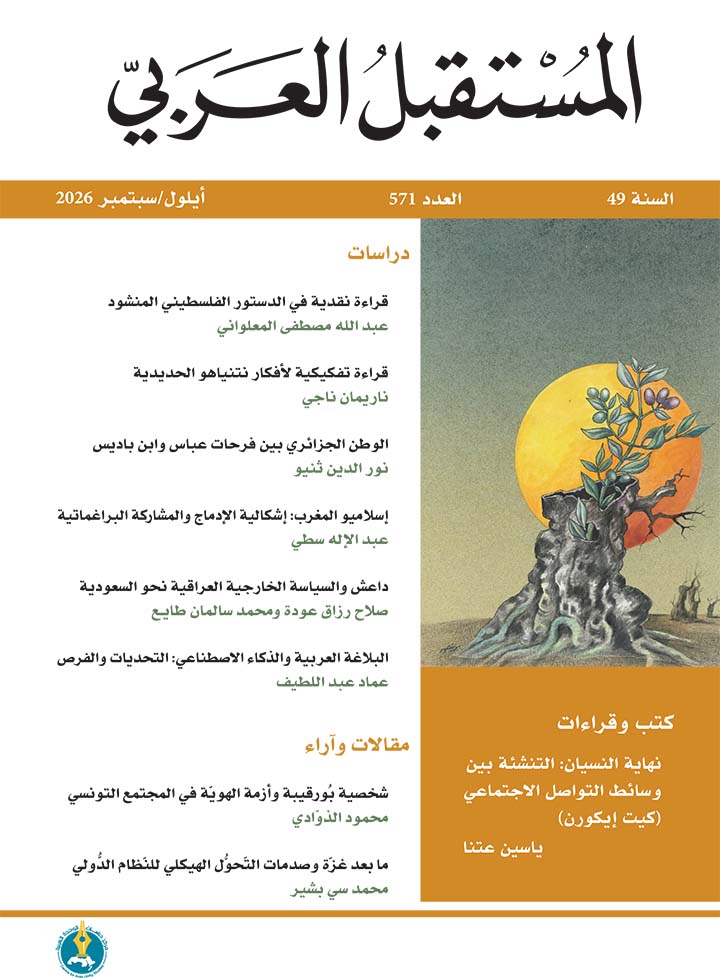
⬜ The Envisioned Palestinian Constitution: The Dilemma of the Hybrid
System and the Distortion of the Separation of Powers
Abdullah Mustafa Al-Malwani 7
https://doi.org/10.65506/260901
The central concern of this study lies in the adoption by the draft Palestinian Constitution for the transitional phase of a hybrid constitutional system that lacks a theoretical foundation in established models of democratic governance. This has produced a state of textual fluidity that undermines the principle of the separation of powers, empties popular sovereignty of its substance, and seeks to legitimize authoritarianism and executive overreach through the constitutionalization of exceptional practices, rather than establishing a state of institutions that transcends the exceptional condition. The study concludes that the draft Constitution represents an attempt to constitutionalize dependency and hollow out the liberation project in favor of an authoritarian bureaucracy of uncertain identity. The study stresses the necessity of breaking with the legacy of Oslo and establishing a new social contract that restores popular sovereignty and reaffirms the National Charter as a unifying framework for Palestinians inside and in the diaspora.
Keywords: Palestinian Constitution; hybrid system; separation of powers; Palestine Liberation Organization; popular sovereignty; critical theory; self-determination; distributive justice.
⬜ A Deconstructive Reading of Netanyahu’s
Iron Wall Ideas Nariman Naji 28
https://doi.org/10.65506/260902
Since Benjamin Netanyahu was elected leader of the Likud Party in 1993, he has devoted considerable space in his discourse to four ideas that play a pivotal role in the Arab–Israeli conflict. He has repeatedly emphasized these ideas and sought to impose them through force on the ground: peace with the Arabs based on strength; redirecting the course of peace in the region by advancing a new approach; the importance of maintaining control over the West Bank and the Golan Heights; and rejecting the establishment of a Palestinian state. These ideas have become important pillars of his political project and his political and security doctrine. They have also become the mosaic from which Netanyahu constructs the new Middle East he envisions for himself as the leader who will save Israel, for Greater Israel as the national homeland of the Jewish people, and for the Arabs, whom he regards as its eternal enemies.
Keywords: Netanyahu; Jabotinsky; peace through strength; two-state solution; Gaza; genocide; Iron Wall; total victory; normalization; Abraham Accords.
⬜ The Algerian Homeland: Between Ferhat Abbas
and Ibn Badis Noureddine Thénio 50
https://doi.org/10.65506/260903
This study sheds light on the role of Ferhat Abbas and Abdelhamid Ibn Badis in shaping the national state in Algeria. The moment of colonialism in Algeria constituted a pivotal moment in affirming a historical, political, and legal reality of the Algerian state in the period following the Second World War. Ferhat Abbas focused on administration, governance, law, the economy, institutions, and public services as means of structuring Algerian society, while Ibn Badis, for his part, waged a moral and cultural struggle through which he sought, through effort and endeavor, to bring Islam and the Arabic language into the public sphere as an indispensable condition for building a homeland for all Algerians, Muslims and even the French.
Keywords: Algerian homeland; Ferhat Abbas; Abdelhamid Ibn Badis; French colonialism; modern state.
⬜ Islamists in Morocco: The Cost of Integration and the
Implications of Pragmatic Participation Abdelilah Satti 67
https://doi.org/10.65506/260904
This study examines the experience of Morocco’s Justice and Development Party (PJD) in government and the effects of its leadership of the Moroccan government for two consecutive terms at the organizational and ideological levels, as well as on the party’s electoral popularity. The study shows how the Islamists in government were willing to compromise their ideology and subject it to the will of the ruler. It also reveals how, in the course of making concessions to achieve their goal of integration into the political process, the PJD’s elites set no limits on the concessions they were prepared to make. This led them to adapt their reform orientations to policies imposed from above, even when those policies conflicted with their convictions.
Keywords: integration; adaptation; moderation; political pragmatism; Moroccan Islamists; monarchy.
⬜ Arabic Rhetoric and Artificial Intelligence:
Challenges and Opportunities Imad Abdel-Latif 84
https://doi.org/10.65506/260905
In recent years, artificial intelligence has witnessed tremendous advances in its ability to perform rhetorical tasks. It has become capable of producing, analyzing, and critiquing texts, as well as delivering public speeches, presenting the world with numerous opportunities, challenges, and risks. This study explores the services that artificial intelligence provides to teachers and students of Arabic rhetoric and identifies three risks that artificial intelligence poses to Arabic rhetoric: the originality of machine-generated rhetorical products, cognitive bias, and the manipulation of audiences. The study proposes four strategies for addressing these risks: understanding how humans respond to machine rhetoric; developing policies and legislation concerning machine-generated rhetorical products; addressing the shortage of Arabic rhetorical content online; and exploring the stylistic characteristics of machine creativity.
Keywords: Arabic rhetoric; artificial intelligence; rhetoric education; digital discourse; cognitive bias; machine-generated texts.
⬜ The Impact of ISIS’s Rise on Iraqi Foreign Policy toward
Saudi Arabia Salah Razzaq Awda and Hamad Salman Tayeh 106
https://doi.org/10.65506/260906
The rise of ISIS represented a major turning point in the trajectory of Iraqi foreign policy. Dealing with external challenges was no longer governed by traditional considerations; rather, it became linked to the necessity of confronting an existential threat that imposed a reshaping of priorities and choices. Iraq thus shifted from a state seeking to restore its position after the U.S. occupation to a state engaged in a complex network of regional and international alliances. This marked a transition to a new pattern of foreign behavior. The study focuses on Iraq’s foreign policy toward Saudi Arabia, which, after 2003, was characterized by a degree of mistrust and caution due to factors related to regional competition with Iran, the accumulated consequences
of the errors of Saddam’s regime and their repercussions for the region, and Iraq’s domestic situation.
Keywords: ISIS terrorism; Iraqi foreign policy; foreign policy change; Iraq and Saudi Arabia.
⬛ Articles and Opinions
⬜ The Identity Crisis in Tunisian Society and Its Relationship
to Bourguiba’s Personality Mahmoud Al-Dhawadi 126
https://doi.org/10.65506/260907
⬜ Post-Gaza: The Ten Shocks in the Structural Transformation
of the International System Mohamed Si Béchir 136
https://doi.org/10.65506/260908
⬛ Books and Reviews
⬜ The End of Forgetting: Socialization in the Age of Social Media
(Kate Eichhorn) Yassine Atana 153
https://doi.org/10.65506/260909
⬜ Selected Arabic and Foreign Books
and Research Reports GabyAl-Khoury 159
Arabic Books: The Zionist Lobby on Both Sides of the Atlantic; Turkish Foreign Policy Toward the Arab Mashreq Since 2016: Iraq and Syria as Case Studies: Palestinian Resistance in the Context of Global Liberation Movements: A Comparative Study of Structures and Strategies; Between Revelation and Interpretation: Justice and
Benevolence in Deconstructing Sectarianism.
Foreign Books: Global Gulf: Geo-Economic, Geo-Political, and Geo-Technological Transformation in Saudi Arabia, the United Arab Emirates, and Qatar; The Coming Storm: Power, Conflict, and Warnings from History; Mineral War: China’s Quest for Weapons of Mineral Destruction; Undergrounding: The Architecture of Genocide.
Research Reports: The U.S.-Led Middle East Order Is Over: The Mecca Agreement Proves It,» and «The Value of U.S. Land Power».
Add a review
You must be logged in to post a review.
You May Also Like
The ARAB FUTURE (AL MUSTAQBAL AL ARABI), No. 559, September 2025
Price range: 2 $ through 3 $
The ARAB FUTURE (AL MUSTAQBAL AL ARABI), No. 556, June 2025
Price range: 2 $ through 3 $
The ARAB FUTURE (AL MUSTAQBAL AL ARABI), No. 547, September 2024
Price range: 2 $ through 3 $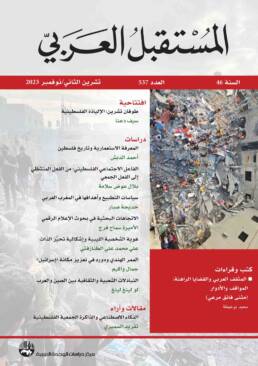
The ARAB FUTURE (AL MUSTAQBAL AL ARABI), No. 537, November 2023
Price range: 2 $ through 3 $
The ARAB FUTURE (AL MUSTAQBAL AL ARABI), No. 529, March 2023
Price range: 2 $ through 3 $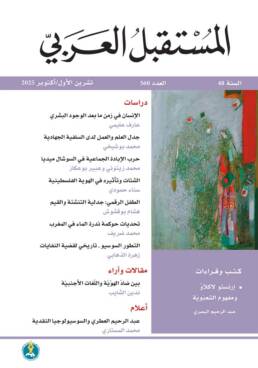
The ARAB FUTURE (AL MUSTAQBAL AL ARABI), No. 560, October 2025
Price range: 2 $ through 3 $