Studies
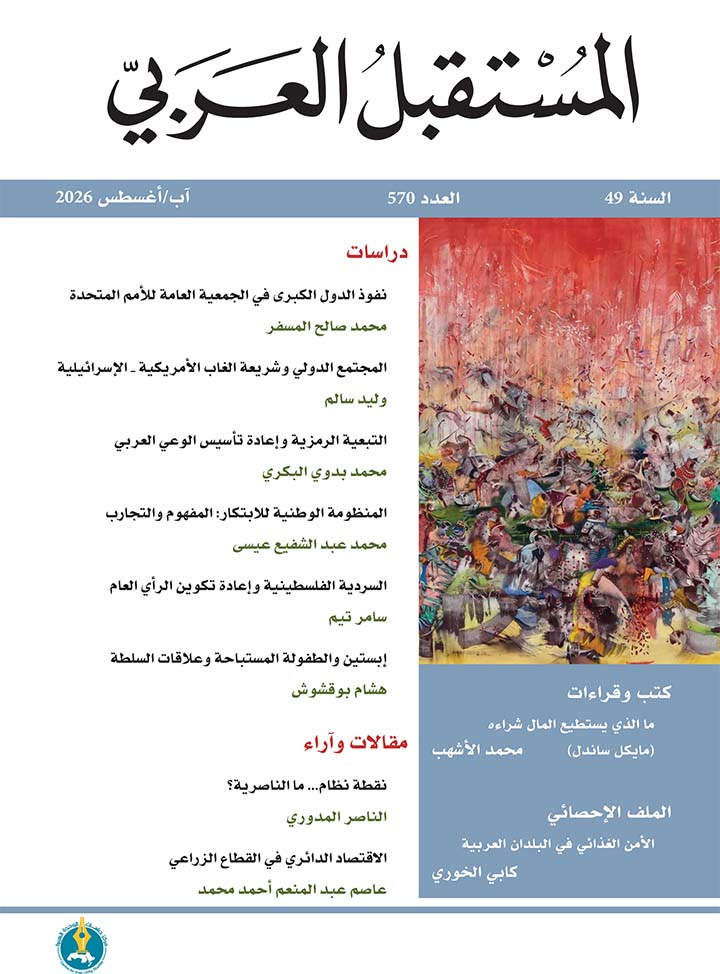
⬜ The Influence of Major Powers in the United Nations
General Assembly: Instruments of Influence and Their Limits
Mohammed Saleh Al-Musfir 7
https://doi.org/10.65506/260801
This study examines the influence of major powers within the United Nations General Assembly and explores the unequal instruments they use to shape voting on General Assembly resolutions. It argues that major powers employ a range of economic, diplomatic, media, and political tools, while exerting both formal and informal pressure—including conditional aid, bilateral alliances, strategic narrative-building, and networks of economic dependence—to influence voting patterns and the drafting of resolutions. As a result, General Assembly decisions often reflect prevailing power balances more than the collective will of member states. The study contributes to the literature on United Nations reform by offering practical recommendations to strengthen the independence of Global South countries and enhance their capacity to withstand external pressures.
Keywords: United Nations General Assembly; major powers; international influence; global governance; instruments of influence; institutional legitimacy; international relations.
⬜ The International Community: From Double Standards
to the American–Israeli Law of the Wild? Walid Salem 28
https://doi.org/10.65506/260802
This paper argues that the power structure within the so-called «international system» or «international community» has, over the past decade, shifted from a framework characterized by the selective application of norms—a defining feature since the establishment of the League of Nations in 1919 and later the United Nations in 1945—to a new phase in which the United States and Israel seek to impose a «law of the jungle.» According to the paper, this entails normalizing policies of genocide, displacement, territorial expansion, and settler-colonial replacement within the international system and beyond. The paper examines the transformations affecting the international community, the evolution of U.S.–Israeli relations, and their current agenda as two settler-colonial powers seeking to dominate the international order and its institutions through projects such as Greater Israel and the expanded New Middle East.
Keywords: international community; international system; settler colonialism; genocide; Greater Israel; expanded Greater Middle East; geopolitical project.
⬜ Symbolic Dependency and the Reconstruction of Arab
Consciousness: From the Loss of Sovereignty to the Engineering
of Meaning Mohammed Badawi Al-Bakri 47
https://doi.org/10.65506/260803
This study introduces the concept of «symbolic dependency» as a deeper framework of contemporary domination, whereby societies lose their ability to define themselves and establish their own standards through the adoption of external languages, images, and concepts. This process reproduces political and economic dependency at the level of consciousness itself. Through an analysis of forms of symbolic colonialism in media, education, and digital spaces, the study argues that the crisis of the Arab world is a crisis of meaning before it is a crisis of institutions.
The study presents a practical framework based on a threefold process: the liberation of concepts, the liberation of images, and the liberation of discourse, with the aim of restoring epistemic sovereignty and developing an open, self-defined frame of reference. It also proposes a sectoral roadmap for reconstructing an active Arab consciousness capable of producing meaning within the global system.
Keywords: symbolic dependency; epistemic sovereignty; symbolic engineering; sovereign consciousness; Arab discourse; cultural colonialism; meaning production; cultural diplomacy.
⬜ The National Innovation System: General Concept and Leading
Experiences Mohammed Abdel Shafie Issa 70
https://doi.org/10.65506/260804
Despite the significant importance that developmental economic thought attributes to the concept of the «National Innovation System» as a fundamental building block for scientific and technological advancement, sufficient studies on the subject have yet to emerge in Arabic. This study examines the origins of the concept within the frameworks of development theory and development practices. It explores the emergence of the concept in modern economic thought, its key scholars, and its main pillars. It also examines its evolution in light of transformations in global thinking since the 1990s, particularly the shift from focusing on the concept of the «science and technology system» to the «National Innovation System.» The study further traces developments and adaptations introduced to the concept at both the Arab and global levels in the new millennium. It also discusses the experiences of selected countries in implementing innovation programs.
Keywords: political economy; development; technological advancement; national innovation system; artificial intelligence; role of the state.
⬜ The Palestinian Narrative in the Era of Genocide: Reconstructing
Public Opinion Samer Tayem 85
https://doi.org/10.65506/260805
This study examines the role of citizen media in reshaping public opinion in conflict zones, with particular focus on the Gaza Strip. In recent years, citizen media has become a vital and essential tool enabling ordinary individuals, regardless of their professional or educational backgrounds, to report news and document events directly and rapidly through various social media platforms, thereby bypassing the strict limitations and extensive censorship faced by traditional mainstream media.
Citizen media empowers ordinary people to share their stories and daily experiences, providing an authentic and grounded voice for affected communities, particularly in conflict environments characterized by sensitivity and complexity.
Keywords: citizen journalism; public opinion; Gaza; armed conflicts; social media platforms; community participation; political awareness; digital content.
⬜ Epstein and Exploited Childhood: Child Sexual Trafficking within
Power Relations Hicham Boukchouch 100
https://doi.org/10.65506/260806
This study examines child sexual trafficking from a critical sociological perspective, viewing it as a structural phenomenon embedded in relations of power and privilege within the global social order, rather than as merely isolated individual acts of deviance. The study begins from a central paradox: despite the moral and legal criminalization of these crimes, they continue to expand within spaces protected by impunity.
Its findings show that child sexual trafficking is reproduced through the intersection of sexuality and power, the normalization of inaction within privileged circles, and the establishment of impunity as a functional mechanism of operation. The study concludes that addressing this phenomenon requires a comprehensive structural dismantling of the conditions that enable it, the strengthening of transnational accountability mechanisms, and the reaffirmation of child rights beyond selective approaches and the political exploitation of scandals.
Keywords: child sexual trafficking; power; impunity; organized crime; critical sociology.
⬛ Articles and Opinions
⬜ A Point of Order:What Is Nasserism? Al-Nasser Al-Madouri 114
https://doi.org/10.65506/260807
⬜ The Circular Economy in the Agricultural Sector: Are There New
Income Pathways? Assem Abdel Moneim Ahmed Mohammed 125
https://doi.org/10.65506/260808
⬛ Books and Readings
⬜ What Money Can’t Buy (Michael Sandel) Mohammed Al-Ashhab 133
https://doi.org/10.65506/260809
⬜ Selected Arabic and Foreign Books and
Research Reports GabyAl-Khoury 142
Arabic Books: The Political Time Gap: Palestine Between the Acceleration of Colonialism, the Stagnation of Structure, and the Redefinition of the Possible; The Lebanese–Lebanese Dialogue: The Presence of Sects and the Absence of the Nation (1975 as a Case Study): Formation and Issues Raised (Part One); The Arabian Gulf in a Time of Difficult Choices, 2020–2025; Liberalism Turns Against Itself; Cold War Thinkers and the Making of Contemporary Time.
Foreign Books: Rising for Palestine: Africans in Solidarity for Decolonisation and Liberation; Regime Change: Inside the Imperial Presidency of Donald Trump; The Antinomies of Black Marxism: Critique of the Racial Capitalism Paradigm; Why Populists are Winning: And How to Beat Them.
Research Reports: «The Strait of Hormuz: A U.S.-Iran Maritime Flash Point»; «Previewing the Trump-Aoun Meeting: A Make-or-Break Moment for the Israel-Lebanon Agreement».
⬛ Statistical File
⬜ Statistical File (149): Food Security in Arab Countries:
Selected Indicators Gaby Al-Khoury 153
Add a review
You must be logged in to post a review.
You May Also Like
The ARAB FUTURE (AL MUSTAQBAL AL ARABI), No. 561, November 2025
Price range: 2 $ through 3 $
The ARAB FUTURE (AL MUSTAQBAL AL ARABI), No. 531, May 2023
Price range: 2 $ through 3 $
The ARAB FUTURE (AL MUSTAQBAL AL ARABI), No. 566, April 2026
Price range: 3 $ through 5 $
The ARAB FUTURE (AL MUSTAQBAL AL ARABI), No. 544, June 2024
Price range: 2 $ through 3 $
The ARAB FUTURE (AL MUSTAQBAL AL ARABI), No. 571, September 2026
Price range: 3 $ through 5 $
The ARAB FUTURE (AL MUSTAQBAL AL ARABI), No. 572, October 2026
Price range: 3 $ through 5 $