⬛ Studies
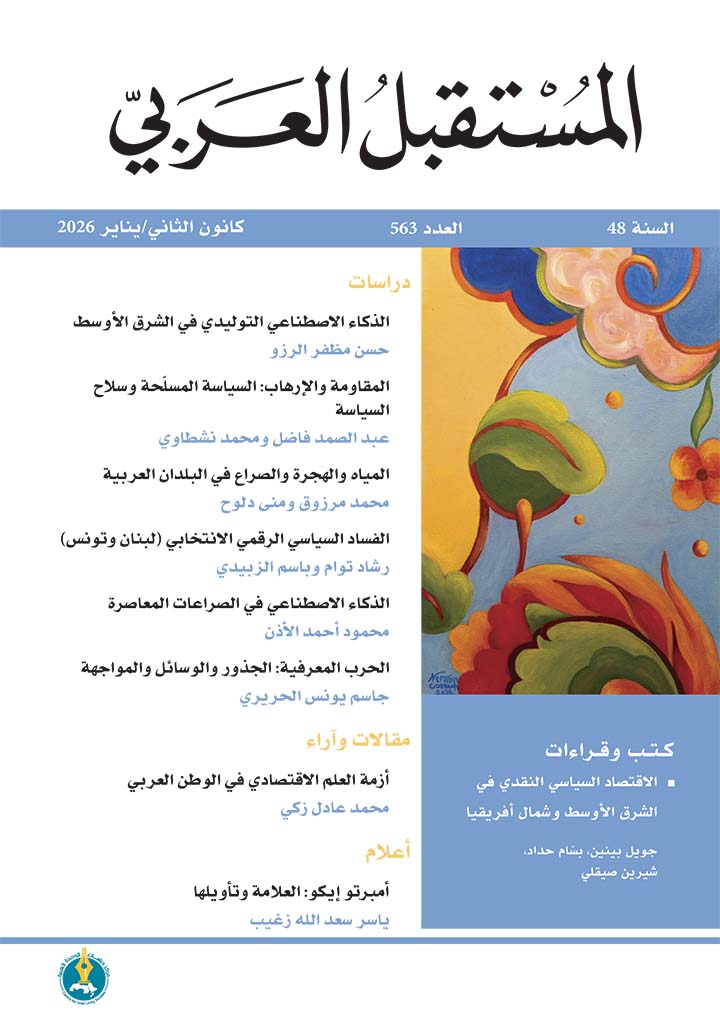
⬜ The Geopolitical Landscape of Generative Artificial Intelligence in
the Middle East: Opportunities and Challenges
Hassan Muzaffar Al-Rizzo 7
https://doi.org/10.65506/26121
The rapid advances in artificial intelligence technology and generative artificial intelligence, along with their applications, have contributed to reshaping the global geopolitical arena. This has created the possibility of a similar transformation in the geopolitical landscape of the Middle East. However, there are obstacles preventing most Arab countries from achieving a qualitative shift within the new global geopolitical order, due to deteriorating infrastructure, limited government investment, political instability in several countries, and brain drain. The Arab Gulf states are an exception to this pattern, as they have embraced artificial intelligence and generative AI technologies, launched national initiatives to develop and employ these technologies, and allocated substantial investment funds to a range of promising initiatives aimed at localizing these new technologies.
Keywords: geopolitical arena, generative artificial intelligence, Middle East, Arab Gulf states.
⬜ Resistance and Terrorism: The Dialectic of Armed Politics and the
Weaponization of Politics Abd al-Samad Fadel
and Mohammad Nachtaoui 27
https://doi.org/10.65506/26122
This paper centers on the fundamental distinction between legitimate resistance, which is recognized by international law as the right of occupied peoples to defend their land and freedom, and terrorism as unlawful violence targeting civilians. The paper criticizes the deliberate conflation of these two concepts, particularly in the context of the Palestinian cause, where legitimate resistance is labeled as terrorism, while state terrorism practiced by Israel against the Palestinian people is overlooked. It also explains how the absence of an internationally agreed-upon definition of terrorism reflects the dominance of political calculations and the geopolitical interests of major powers over legal principles. This conceptual ambiguity is thus exploited to justify unbalanced policies, transforming the legitimate struggle of peoples for liberation into mere terrorist acts.
Keywords: resistance; state terrorism; political violence; international law; interest.
⬜ The Water–Migration–Conflict Nexus in Arab Countries
Mohammed Marzouk and Mona Dallouh 41
https://doi.org/10.65506/26123
This study aims to identify the extent to which the risks of water scarcity and drought affect migration and conflict in Arab countries. It examines the reality of drought and water scarcity in the Arab region and addresses the issues of migration and conflict within the context of drought and water scarcity in the study area. The study also explores the future of migration and conflict amid the escalating phenomena of drought and water scarcity in the region. It concludes that the relationship among migration, conflict, and drought follows a dynamic trajectory that should not be reduced to a linear model; rather, each element both influences and is influenced by the others in the form of feedback loops. The study emphasizes the need to adopt the concept of adaptive migration and to develop international law interventions to mitigate conflict and violence.
Keywords: drought; water scarcity; migration; conflict; Arab countries.
⬜ From Screen to Ballot Box: Digital Political Corruption in Elections (The
Cases of Lebanon and Tunisia) Rashad Twam and Basem Al-Zubaidi 57
https://doi.org/10.65506/26124
This study introduces the concept of «digital political corruption» to describe the impact of social media platforms on the integrity of the electoral process. The study is based on the hypothesis that these platforms have become a parallel authority in the electoral field, sometimes used as tools for misinformation, manipulation of information, and shaping public opinion, thereby affecting the free will of voters. The study examines the Lebanese and Tunisian experiences and concludes that the legal systems in both countries are unable to fully address the forms of digital political corruption. It also notes the disparities in the capacity of electoral administrations to handle violations and the weak integration between law, ethics, and relevant international standards. The study offers recommendations to bridge regulatory gaps and ensure the integrity of elections in the digital age.
Keywords: social media platforms, election monitoring, election integrity, electoral misinformation, electoral administration, electoral law, electoral judiciary.
⬜ From Sword to Algorithm: The Evolution of Warfare Tools
Throughout History and the Impact of Artificial Intelligence on
Contemporary Conflicts Mahmoud Ahmed Al-Ozon 87
https://doi.org/10.65506/26125
Human societies have experienced conflicts since the dawn of history, with warfare continuously evolving alongside social, economic, cultural, and technological advancements. This evolution ranges from the use of simple handheld weapons to the era of artificial intelligence, where algorithms are now capable of making battlefield decisions without human intervention. This raises ethical and legal questions about the future of conflicts. The war in Gaza following the Al-Aqsa Flood, marked by excessive use of AI in target detection, tracking, and strikes among civilians, highlights the potential humanitarian risks and ethical violations associated with relying on AI in conflicts.
Keywords: wars, weapons, artificial intelligence, smart weapons, ethical violations.
⬜ Cognitive Warfare Between States: Roots, Methods, and Ways of
Confrontation Jasim Younis Al-Hariri 107
https://doi.org/10.65506/26126
This study addresses cognitive warfare, which targets the human mind by integrating cyber, informational, psychological, and social capabilities to create confusion, misinformation, and uncertainty. This is achieved through information overload or misleading information, focusing attention on false targets, causing distraction, presenting false narratives, radicalizing individuals, and amplifying social polarization. Cognitive warfare has the potential to destabilize societies and military organizations and to break alliances. The study concludes with several key insights, including that cognitive warfare aims to target the human mind and control emotions and feelings. It operates both in times of peace and war by sending messages through the virtual world filled with lies, deception, and misinformation to influence audiences.
Keywords: cognitive warfare, interstate conflict, confrontation methods, cyber capabilities, misinformation, virtual world.
⬛ Articles and Opinions
⬜ The Crisis of Economic Science in the Arab World
Mohammed Adel Zaki 126
https://doi.org/10.65506/26127
⬛ Flags
⬜ The Italian Philosopher Umberto Eco: His Signs and Their
Interpretation Yasser Saadallah Zoughaib 133
https://doi.org/10.65506/26128
⬛ Books and Reviews
⬜ A Critical Political Economy in the Middle East and North Africa
(Joel Beinin, Bassam Haddad, Shireen Seikaly) Ali Najat 151
https://doi.org/10.65506/26129
⬜ Selected Arabic and Foreign Books
and Research Reports Gaby El-Khoury 161
Arabic Books: America: Realities and Trajectories; Imperialism and waste; Digital Palestinian Memory: Forms, Challenges, and Future Prospects; The Identity Trap.
Foreign Books: On Antisemitism: A Word in History; Genocide Bad: Notes on Palestine, Jewish History, and Collective Liberation; Surviving the Twenty-First Century; Contemporary Far-Right Culture: The Art, Music, and Everyday Practices of Violent Extremism.
Research Reports: By Endorsing the U.S. Gaza Plan, the UN Security Council Elevates ‘Rule by Law’ Over Rule of Law; A Look Back at 2025: The Year in Foreign Policy.

Add a review
You must be logged in to post a review.
You May Also Like

The ARAB FUTURE (AL MUSTAQBAL AL ARABI), No. 555, May 2025
Price range: 2 $ through 3 $
The ARAB FUTURE (AL MUSTAQBAL AL ARABI), No. 536, October 2023
Price range: 2 $ through 3 $
The ARAB FUTURE (AL MUSTAQBAL AL ARABI), No. 545, July 2024
Price range: 2 $ through 3 $
The ARAB FUTURE (AL MUSTAQBAL AL ARABI), No. 534, August 2023
Price range: 2 $ through 3 $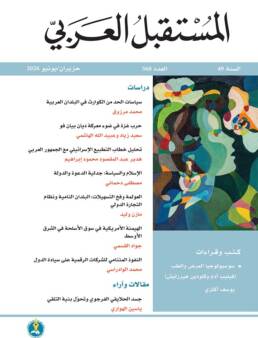
The ARAB FUTURE (AL MUSTAQBAL AL ARABI), No. 568, June 2026
Price range: 3 $ through 5 $
The ARAB FUTURE (AL MUSTAQBAL AL ARABI), No. 541, March 2024
Price range: 2 $ through 3 $