
Studies
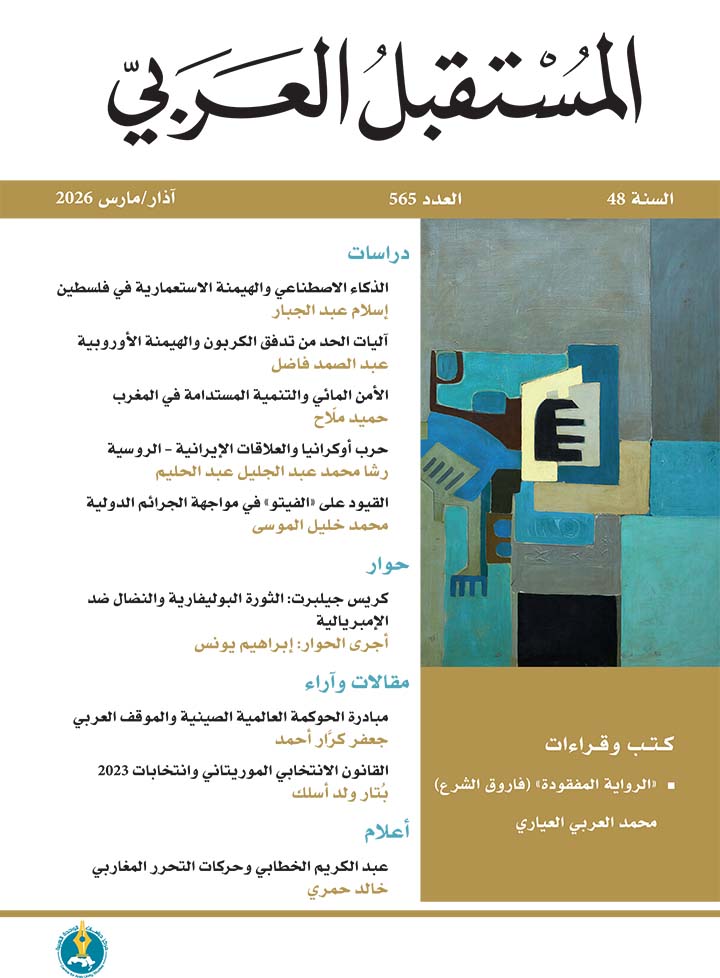
⬜ Artificial Intelligence and the Reimposition of Colonial Hegemony in
The West Bank and Gaza Strip Islam Abdel Jabbar 7
https://doi.org/10.65506/25201
This study offers a critical reading of how Israel reproduces the system of settler colonialism in Palestine through the deployment of artificial intelligence as a central tool in engineering domination and control. It begins by deconstructing the ideological foundations of the Zionist project as a form of settler colonialism based on erasing Palestinian presence and dehumanizing the indigenous population. The study shows how smart technologies have shifted from being tools of surveillance to becoming systematic mechanisms of destruction used to generate human and spatial targets with minimal human intervention. It traces the strategic transformation from the «Dahiya Doctrine» to the «Jabalia Doctrine,» which legitimizes the mass targeting of civilians. The paper also discusses the unethical use of artificial intelligence in violation of international humanitarian law.
Keywords: settler colonialism, digital colonialism, artificial intelligence and genocide, West Bank and Gaza Strip, religious Zionism, indigenous people, cyber warfare.
⬜ Carbon Border Adjustment Mechanisms as a Tool for Consolidating
European Hegemony and Their Implications for the Arab
World Abdel Samad Fadel 29
https://doi.org/10.65506/25202
This paper analyzes the European Union’s Carbon Border Adjustment Mechanism (CBAM), adopted to strengthen its efforts to combat climate change. The mechanism extends beyond EU borders, affecting countries worldwide and representing a transcontinental environmental policy. Arab countries are directly concerned with the implications of this new European measure, which imposes a «carbon tax» on specific exported goods destined for the EU market. The paper provides an in-depth analysis of this new European mechanism, examines its impact on Arab countries as emerging economies, and evaluates their capacity to respond, particularly given that most have national plans and programs to address climate change.
Keywords: realism, European Union, Arab countries, environmental policy, carbon.
⬜ Water Security and Sustainable Development in Morocco in Light of
Climate Change Hamid Mallah 48
https://doi.org/10.65506/25203
The water dilemma is one of the most pressing security issues on the global agenda in the twenty-first century. It represents a growing future security challenge that requires necessary measures to ensure sustainable water security as an essential condition for living in a safe and sustainable environment. Morocco is among the countries suffering from this dilemma due to several factors, most notably climate change, drought, desertification, siltation of dams, pollution, demographic growth, and increasing water demand. Although Morocco has adopted a clear and proactive water policy characterized by long-term planning and strategic foresight, climate variability and rising water demand require urgent actions and measures to safeguard its water security.
Keywords: Morocco, water scarcity, securitization, water security, climate change, sustainable development.
⬜ The Ukraine War and the Development of Iranian–Russian
Relations Rasha Mohamed Abdel Galil Abdel Halim 69
https://doi.org/10.65506/25204
This study examines the impact of the Russian–Ukrainian crisis on the development of relations between Iran and Russia, employing a structural realist approach that emphasizes the role of the international system’s structure in shaping state behavior and strategic trajectories. The study highlights how relations between Moscow and Tehran have shifted from a temporary convergence of interests to an institutionalized strategic partnership, within the broader structural transformations that have reshaped global power balances since 2022. The analysis begins by outlining the strategic objectives of both Russia and Iran over the past two decades, tracing the trajectory of bilateral relations prior to the Ukrainian crisis, and then identifying the changes imposed by the war, including the new constraints and opportunities it has generated.
Keywords: Iran, Russia, Ukrainian crisis, strategic partnership, pivot to the East, Western sanctions.
⬜ Legal Constraints on the Veto in the Face of International
Crimes Mohammad Khalil Al-Mousa 88
https://doi.org/10.65506/25205
State practice concerning the use of the veto—particularly in situations involving the commission of serious international crimes such as genocide, crimes against humanity, and war crimes—reveals the catastrophic consequences that may result from the misuse or threat of misuse of the veto. Such use can obstruct the adoption of measures aimed at preventing or halting these crimes.
This study seeks to address the problem arising when one or more permanent members of the United Nations Security Council employ the veto to block the adoption of resolutions that include measures or obligations intended to confront situations in which such crimes are being committed or are likely to be committed. The research argues that this practice can facilitate the perpetration of international crimes and embolden those responsible for committing them.
Keywords: war crimes, Security Council, permanent members, veto power, international balances, international resolutions.
⬛ Interview
⬜ With Chris Gilbert: The Bolivarian Revolution in Venezuela and the
Global Struggle by Ibrahim Younis 105
https://doi.org/10.65506/25206
⬛ Articles and Opinions
⬜ China’s Global Governance Initiative and the International
Governance System: The Arab Position Jaafar Karrar Ahmed 116
https://doi.org/10.65506/25207
⬜ The New Mauritanian Electoral Law in Light of the 2023
Elections Boutar Weld Aslak 124
https://doi.org/10.65506/25208
⬛ Flags
⬜ Abdelkrim El Khattabi and His Role in Unifying the Maghrebi
Liberation Movements Khaled Homri 135
https://doi.org/10.65506/25209
⬛ Books and Reviews
⬜ «The Missing Narrative»
(Farouk Al-Sharaa) Mohamed Al-Arabi Al-Ayari 142
https://doi.org/10.65506/25210
⬜ Selected Arabic and Foreign Books
and Research Reports Gaby El-Khoury 157
Arabic Books: Islam and Postmodernity: Deconstructing the Rupture and Resuming Construction; New communication technologies among Arabs: elites, contexts, and patterns; The Image of Israel in Modern Egypt; Ideas, Intellectuals, and Foreign Policy from the Era of Nasser to the Era of Mubarak; Modern and Contemporary History of Lebanon 1516-2026.
Foreign Books: Liberal Peacebuilding in Times of Change: The UN, the EU, and the Politics of Continuity; Anti-Corruption in a Discordant World Contestation, Abuse, and Innovation; Israel and the Gaza Strip since 1967: A History of Occupation, Domination and Unilateralism; Who Paid the Pipers of Western Marxism?
Research Report: «An Opportunity for Calm in North-eastern Syria»; «If Trump Strikes Iran: Mapping the Oil Disruption Scenarios»
Add a review
You must be logged in to post a review.
You May Also Like
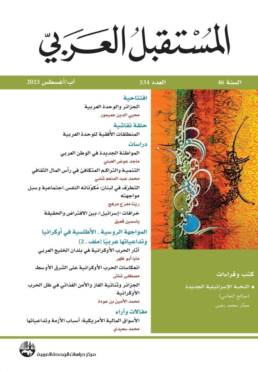
The ARAB FUTURE (AL MUSTAQBAL AL ARABI), No. 534, August 2023
Price range: 2 $ through 3 $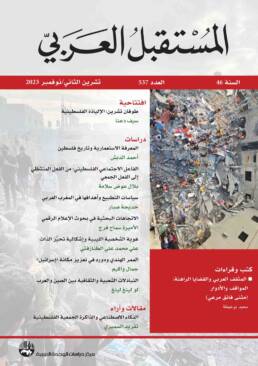
The ARAB FUTURE (AL MUSTAQBAL AL ARABI), No. 537, November 2023
Price range: 2 $ through 3 $
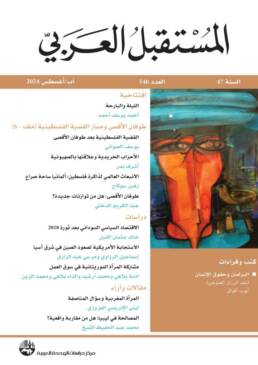
The ARAB FUTURE (AL MUSTAQBAL AL ARABI), No. 546, August 2024
Price range: 2 $ through 3 $
The ARAB FUTURE (AL MUSTAQBAL AL ARABI), No. 538, December 2023
Price range: 2 $ through 3 $