Editorial
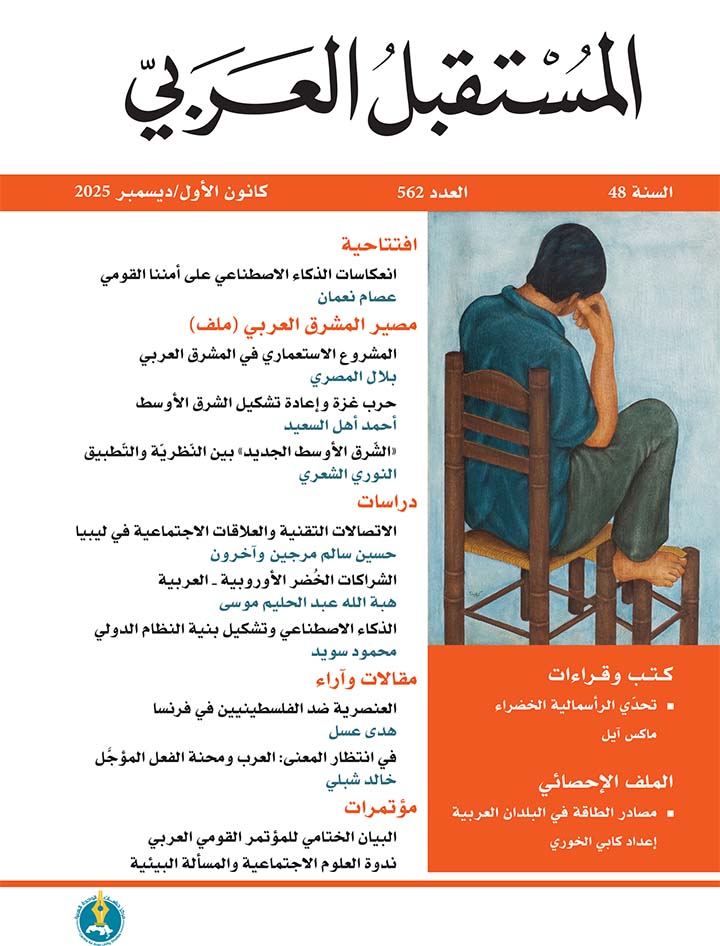
⬜ Implications of Artificial Intelligence on Our
National Security Issam Naaman 7
⬛ The Arab Mashriq’s Future: A Special File
⬜ The American–Israeli Colonial Project in the Middle East and Its
Impact on the Arab Nation-State Bilal Al-Masri 11
The American–Zionist project is a long-term plan to dominate the broader Middle East. Its pillars are ideological, political, and military. Among its goals is the establishment of flexible local regimes that can be controlled. The Arab system suffers from erosion in both legitimacy and sovereignty, as many Arab regimes were—and continue to be—tools in implementing the American–Zionist project. Operation Al-Aqsa Flood represents a practical turning point confronting the American–Israeli project. It stands as a model of resistance supported by popular steadfastness and organized, professional military operations, marking a major historical shift. However, there are ongoing American attempts to establish military control over Gaza to serve American–Zionist interests. Within this framework, the American plan includes creating a military base on the outskirts of Gaza as part of this broader project.
Keywords: Arab Mashriq, Middle East, American–Zionist project, Gaza, Al-Aqsa Flood.
⬜ Gaza War and the Reshaping of the
Middle East Ahmed Ahl Al-Saeed 25
Israel’s war against the Gaza Strip has triggered widespread global outrage and opened the door to profound questions about the future of international humanitarian law, the effectiveness of the United Nations, the role of international organizations, and even the relevance of the Arab League. This war is exceptional by every measure—not only terms of the scale of destruction or the number of casualties, but also because it is likely to produce a qualitative shift in the balance of power among actors in the Middle East.
This study aims to shed light on how the Gaza war is influencing the redrawing of power dynamics in the region, while analyzing the role of the Israeli–American project in shaping a «new Middle East,» and presenting the contribution of the resistance in confronting this project.
Keywords: Middle East, Gaza, war, Israel, United States, resistance.
⬜ Reconfiguring the Middle East: A Critical Reading of the «New Middle
East» Concept Between Theory and Practice Al-Nouri Al-Sha‘ri 41
This study offers an in-depth critique of the concept of the New Middle East, seeking to understand its historical and political evolution within the context of shifting power dynamics and the interaction of states and societies with this concept. The study aims to shed light on the role of resistance movements and popular forces in reshaping regional balances and influencing policy trajectories, based on a precise understanding of the foundations of power and its manifestations at both the regional and international levels. The study also provides an analysis of the gaps between theory and practice, demonstrating how to achieve harmony between strategic visions and actions on the ground. In light of these insights, it presents frameworks and premises for an alternative vision of the Middle East—one grounded in balanced power dynamics and enhanced regional stability—thereby contributing to the prospect of a more secure future.
Keywords: Al-Aqsa Flood, genocide warfare, New Middle East, regional balances.
⬛ Studies
⬜ The Technological Communications Network and Social Relations
in the Libyan Community: Between Cohesion
and Fragmentation Hussein Salem Merjeen 61
This article sheds light on the profound changes that have affected Libya’s social relations network after 2011, leading to its fragmentation. The article relies on a brainstorming methodology conducted among a group of sociology researchers in Libyan universities, which enriched the comprehensiveness and depth of the analysis. This approach reflected a qualitative level of interaction and inclusiveness aimed at producing deeper insights and an analysis that goes beyond traditional academic methods. The article indicates that the network of social relations in Libyan society has gone through extremely difficult phases that resulted in its dispersal into tribal or regional groupings, each managing its own daily affairs independently. The article argues for the need to adopt a new vision for rebuilding this social network.
Keywords: social relations network, Libyan society, network fragmentation, network cohesion.
⬜ The European-Arab Green, Climate, and Energy Partnerships:
Between Discourse and Practice Hebaallah Abdel-Halim Moussa 74
This study seeks to deconstruct the environmental discourse employed by the European Union in its policy toward Arab countries, within the framework of its self-promotion as a green normative power. The study provides a critical analysis of the climate and energy partnerships between the two sides, noting that practical experience shows these partnerships often impose constraints that limit the ability of Arab countries to formulate environmental solutions suited to their local specificities. This reality raises serious questions about the degree of consistency between the EU’s actual practices and the discourse through which it presents itself as a green normative actor. The gaps between the EU’s official narrative and on-the-ground realities reveal fundamental challenges to its ability to fulfill this normative role.
Keywords: European Union, Arab countries, climate and energy partnerships, environment, green normativity.
⬜ The Impact of Artificial Intelligence on Government Policies and Its Role
in Shaping the Structure of the International System Mahmoud Sweid 94
This research examines the effects of the Fifth Industrial Revolution, represented by artificial intelligence (AI) technologies, on both government policies and the international system, highlighting the depth of the gap and inequalities between countries. It also addresses a hypothesis related to international competition based on automatic cycles of innovation, which assumes no constraints on developing the infrastructures necessary for AI technology. This situation makes it difficult to identify a single country or a group of countries as the center of the Fifth Industrial Revolution at this early stage. Therefore, this revolution is considered a key factor that amplifies the possible perceptions and scenarios regarding how the structure through which values will be distributed among the units of the future international system will be formed.
Keywords: artificial intelligence, innovation, Fifth Industrial Revolution, international system, technological gap.
Articles & Opinions
⬜ It Is Time to Talk About Racism Against Palestinians
in France Huda Asal 110
⬜ Awaiting Meaning: Arabs and the Ordeal of
Deferred Action Khaled Shibli 118
⬛ Conferences
⬜ Final Statement of The Arab National Conference, 34th Session
(Beirut, 7-9 November 2025), 128
⬜ Symposium: «Social Sciences and the Environmental Question: Issues
and Approaches» Ibn Tofail University, Morocco,
6 March 2024 Mohammad Al-Dahani & Youssef Al-Tassi 134
⬛ Books & Readings
⬜ Challenging Green Capitalism: Climate Justice and the Energy
Transition in the Arab Region Max Ayl 140
⬜ Selected Arabic and Foreign Books
and Research Reports Gaby El-Khoury 149
Arabic Books: Balconies for Contemplation, Thinking, and Reflection; The Flood of Al-Aqsa: Studies in Conflict and Fate; Deconstructing Salafism It’s Transformations and Modifications From Scholarly Assemblies to Battlefields; Genocide in Gaza: Israel’s Prolonged War on Palestine.
Foreign Books: Why Immigration Policy Is Hard: And How to Make It Better; The Age of Change: How Urban Youth Are Transforming African Politics; Arrested Movement in the Middle East: Mobility and Political Dissent in Arab and Palestinian Culture; Saudi Arabia in the Anglo-American Press: Covering the Kingdom during the 20th Century.
Research Reports: What Is the Extent of Sudan’s Humanitarian Crisis?»; «Unpacking the China File in U.S.-Saudi Relations».
⬛ Statistical File (148)
⬜ Energy Sources in Arab Countries Gaby Al-Khoury 164
Add a review
You must be logged in to post a review.
You May Also Like

The ARAB FUTURE (AL MUSTAQBAL AL ARABI), No. 558, August 2025
Price range: 2 $ through 3 $
The ARAB FUTURE (AL MUSTAQBAL AL ARABI), No. 527, January 2023
Price range: 2 $ through 3 $
The ARAB FUTURE (AL MUSTAQBAL AL ARABI), No. 543, May 2024
Price range: 2 $ through 3 $
The ARAB FUTURE (AL MUSTAQBAL AL ARABI), No. 563, January 2026
Price range: 3 $ through 5 $
The ARAB FUTURE (AL MUSTAQBAL AL ARABI), No. 565, March 2026
Price range: 3 $ through 5 $