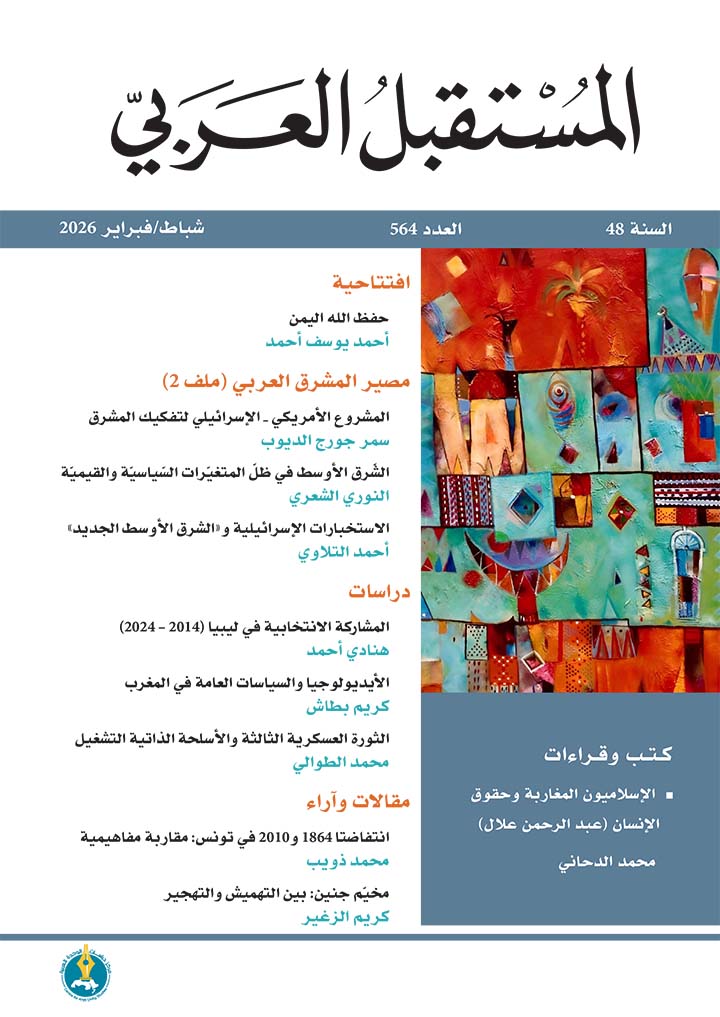
Editorial
⬜ May God Safeguard Yemen Ahmed Youssef Ahmed 7
https://doi.org/10.65506/27101
⬛ The Fate of the Arab Mashreq (File 2)
⬜ The American–Israeli Project to Dismantle the Civilizational Identity of
the Arab Mashreq Samar George Al-Dayoub 11
https://doi.org/10.65506/27102
This study examines projects aimed at dismantling civilizational identity in the Arab Mashreq through an analysis of the cultural and intellectual structures that were formed throughout history and later subjected to processes of reconfiguration under the influence of modernity, colonialism, globalization, and digital transformations. The study is based on the hypothesis that Mashreqi identity is not a fixed structure, but rather a dynamic system in which collective memory interacts with political, religious, and epistemological discourses. The study adopts a critical analytical methodology to explore the mechanisms of dismantling and reconstruction, and concludes that the restoration of civilizational identity is not achieved through isolation, but through a conscious critical reading that reconnects heritage with the concepts of the contemporary age, opening the way for a renewed Mashreqi identity capable of producing knowledge.
Keywords: civilizational identity, Arab Mashreq, dismantling, cultural memory, epistemological discourse, modernity, globalization, reconstruction.
⬜ The Middle East in Light of Current Political and Value Transformations: A
Reading of the Discourse of Actors in the Region Al-Nouri Al-Sha‘ari 31
https://doi.org/10.65506/27103
In recent decades, the Arab region and the Middle Eastern regional space have undergone profound transformations that combine geopolitical dimensions with value-based and ethical ones. Rapid changes in
the balance of power and international relations have led to the reconfiguration of political and societal landscapes, turning this space into an arena of conflict between the logic of «international legitimacy» as an institutional and legal reference, and the logic of «human legitimacy» as a moral and value-based reference.
This study addresses the transformations of the Middle East in light of current political and value-based changes, invoking the debate between international legitimacy and human legitimacy as two conflicting frames of reference in pivotal issues, foremost among them the Palestinian cause. The article contributes to the construction of a critical reading that deconstructs the tensions between the explicit and the implicit, and reveals their role in shaping patterns of regional and international engagement.
Keywords: Middle East, Palestinian cause, international legitimacy, geopolitical changes, Benjamin Netanyahu, Mahmoud Abbas.
⬜ Israeli Intelligence and the Making of the
«New Middle East» Ahmed Al-Tallawi 54
https://doi.org/10.65506/27104
This study traces the roles of Israeli intelligence agencies in implementing Israel’s regional policies, and the functional role these agencies play in executing colonial plans and projects in the Arab world and the Middle East. It does so by examining evidence revealed by current events, as well as the historical roots of these roles since the early beginnings of the Zionist project. The study also addresses the concept of the functional state assumed by Israel and its security institutions within the strategies of colonial powers, based on a relationship of mutual benefit, and situates this role within Israeli security theory.
Furthermore, the study identifies the tools employed by Israel to achieve multi-dimensional penetration in the countries of the region, as well as the factors behind the spread of its intelligence services from the era of the «Jewish Diaspora» to the present day. It also highlights the role of internal problems in Arab countries in facilitating Israeli plans and the strategies of colonial powers in the region.
Keywords: Palestinian cause, Arab–Israeli conflict, security and intelligence affairs, Mossad, Arab affairs, military affairs, Zionism.
⬛ Studies
⬜ Electoral Participation in Libya (2014–2024) Hanadi Ahmed 75
https://doi.org/10.65506/27105
This study examines trends in electoral participation in Libya during the period 2014–2024, documenting and analyzing changes in voter turnout rates. It explores patterns of participation in Libyan elections, the geographical and demographic distribution of turnout, and the factors that may have contributed to explaining these patterns. The study seeks to identify the determinants influencing voter behavior, drawing on publicly available opinion poll results related to Libyan elections, as well as media reports from reliable sources, in order to understand the broader context in which these elections were conducted.
The study also presents a set of recommendations aimed at enhancing electoral participation in Libya, contributing to the development of a democratic and effective electoral system that promotes political stability in the country.
Keywords: Libyan elections, electoral participation, voter behavior, influencing factors, regional division.
⬜ Ideological Dynamics and the Shaping of Public Policies in Morocco: The
Experiences of «Consensual Alternation» and the Justice and
Development Party Karim Battash 91
https://doi.org/10.65506/27106
This study analyzes the relationship between party ideology and the formulation of public policies in Morocco through a comparative examination of the «Consensual Alternation» government (1998–2002) and the Justice and Development Party–led governments (2011–2021). The study highlights the decisive role of regulatory mechanisms—such as technocratic actors and the engineering of governing coalitions—in determining final policy outcomes.
The findings thus underscore the persistence of invisible rules that ensure the primacy and structural stability of systemic imperatives over the ideological ambitions of party actors, even under elected governments grounded in strong value-based references. The study concludes that the ideological influence of ruling parties is not absolute, but rather constitutes a «conditioned space» that expands or contracts depending on the extent of its convergence with the state’s strategic priorities.
Keywords: political ideology, political parties, public policies, Consensual Alternation government, Justice and Development Party government.
⬜ The Third Military Revolution: Autonomous Weapons and Military
Posthumanism Mohammed Al-Tawali 111
https://doi.org/10.65506/27107
At the beginning of the past decade, discussion emerged around unmanned weapons systems that operate autonomously without human intervention, differing from weapons systems that rely on remote human control, such as unmanned aerial vehicles (drones). This sparked extensive debate over these future systems, with actors and observers divided into two main camps: one that defends these systems by highlighting their advantages and characteristics—especially their military benefits—and another that opposes them, focusing on the risks and concerns they may pose at the humanitarian, ethical, and legal levels.
This raises the question of whether the challenges posed by autonomous weapons systems genuinely constitute a threat to humanity when weighed against the opportunities they offer for the future of warfare, or whether such concerns are merely exaggerations resulting from misconceptions about the issue.
Keywords: future of warfare, killer robots, autonomous weapons systems, artificial intelligence, military revolution.
⬛ Articles and Opinions
⬜ The 1864 and 2010 Uprisings in Tunisia:
A Conceptual Approach Mohamed Dhuwaib 131
https://doi.org/10.65506/27108
⬜ Jenin Refugee Camp: Between Marginalization
and Displacement Karim Al-Zghir 142
https://doi.org/10.65506/27109
⬛ Books and Readings
⬜ Moroccan Islamists and Human Rights: Transformations of Discourse and
Practice (Abdelrahman Allal) Mohammed Al-Dahani 155
https://doi.org/10.65506/27110
⬜ Selected Arabic and Foreign Books
and Research Reports Gaby El-Khoury 162
Arabic Books: International Humanitarian Law: Troubling Issues and Painful Choices; When the World Sleeps: Stories, Words, and Open Palestinian Wounds; The Arab Renaissance Project: Ideas on Civilizational Renewal; The Educated Woman in Arabic Fiction: Masculinity Appropriation and the Liberation of the Body.
Foreign Books: The Invisible Coup: How American Elites and Foreign Powers Use Immigration as a Weapon; The Triangle of Power: Rebalancing the New World Order; The Coming Storm: Power, Conflict, and Warnings from History; Syria: A Modern History
Research Reports: «A World Without Rules: The Consequences of Trump’s Assault on International Law»; «Why Trump’s Options Are Limited When It Comes to Using Force against Iran»
Add a review
You must be logged in to post a review.
You May Also Like
The ARAB FUTURE (AL MUSTAQBAL AL ARABI), No. 562, December 2025
Price range: 2 $ through 3 $
The ARAB FUTURE (AL MUSTAQBAL AL ARABI), No. 553, March 2025
Price range: 2 $ through 3 $
The ARAB FUTURE (AL MUSTAQBAL AL ARABI), No. 544, June 2024
Price range: 2 $ through 3 $
The ARAB FUTURE (AL MUSTAQBAL AL ARABI), No. 551, January 2025
Price range: 2 $ through 3 $
The ARAB FUTURE (AL MUSTAQBAL AL ARABI), No. 538, December 2023
Price range: 2 $ through 3 $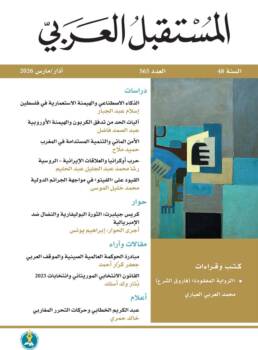
The ARAB FUTURE (AL MUSTAQBAL AL ARABI), No. 565, March 2026
Price range: 3 $ through 5 $